Scilla siberica
Species of flowering plant
From Wikipedia, the free encyclopedia
Scilla siberica, the Siberian squill or wood squill, is a species of flowering plant in the family Asparagaceae, native to southwestern Russia, the Caucasus, and Turkey. Despite its name, it is not native to Siberia.

| Siberian squill | |
|---|---|
| |
Scientific classification  | |
| Kingdom: | Plantae |
| Clade: | Tracheophytes |
| Clade: | Angiosperms |
| Clade: | Monocots |
| Order: | Asparagales |
| Family: | Asparagaceae |
| Subfamily: | Scilloideae |
| Genus: | Scilla |
| Species: | S. siberica |
| Binomial name | |
| Scilla siberica | |
Many parts of the plant such as the flowers, fruits, leaves, roots, sap, seeds, and stem are poisonous to eat for some animals.[3][4]
Description

Growing to 10–20 cm (4–8 in) tall by 5 cm (2 in) wide, it is a bulbous perennial, with two to four strap-shaped leaves appearing in early spring, at the same time as the nodding, blue, bell-shaped flowers.[5]
The flowers have six tepals and six stamens, and are arranged singly or in racemes of two or three. Petals may be reflexed to the horizontal when sunlight is bright, but are more often cup-shaped. The flowers are usually blue, but those of Scilla siberica var. alba are white. The stamens of Scilla are separate, unlike those of the related genus Puschkinia, which are fused into a tube. The pollen is dark blue.
After flowering, the flower stems become limp as capsules (pods) mature. At maturity, the capsules become purple and split open, releasing small, dark brown seeds. When the seeds are mature, the leaves wither and the plant goes dormant until the next spring.
The seedlings are hollow-leaved.
Cultivation
S. siberica is cultivated for its bluebell-like flowers. It naturalizes rapidly from seed. At 15 cm (5.9 in), it is suitable for planting in grass, and will spread by seed to form large colonies that go dormant by the time grass needs to be mowed. This plant has gained the Royal Horticultural Society's Award of Garden Merit.[6][7]
In Minnesota the species is becoming invasive in the eastern counties of the state, from Duluth to Rochester.[8]
Gallery
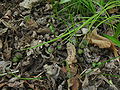 Seed capsules
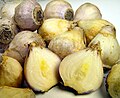 Bulbs
Bulbs Klepacza Park in Łodz, Poland
 Pendulous flowers at various stages of development
 In Calgary, Alberta in April
 Pollen grains under a microscope with different illumination methods (EPI illumination, bright field, differential interference contrast, phase contrast, autofluorescence)


