Mathematical concept in particularly differential topology
In mathematics, particularly differential topology, the secondary vector bundle structure
refers to the natural vector bundle structure (TE, p∗, TM) on the total space TE of the tangent bundle of a smooth vector bundle (E, p, M), induced by the push-forwardp∗: TE → TM of the original projection map p: E → M.
This gives rise to a double vector bundle structure (TE,E,TM,M).
In the special case (E, p, M) = (TM, πTM, M), where TE = TTM is the double tangent bundle, the secondary vector bundle (TTM, (πTM)∗, TM) is isomorphic to the tangent bundle(TTM, πTTM, TM) of TM through the canonical flip.
Proof
Let (E, p, M) be a smooth vector bundle of rank N. Then the preimage (p∗)−1(X) ⊂ TE of any tangent vector X in TM in the push-forward p∗: TE → TM of the canonical projection p: E → M is a smooth submanifold of dimension 2N, and it becomes a vector space with the push-forwards
of the original addition and scalar multiplication
as its vector space operations. It becomes clear actually defines addition on the fibers of as . The triple (TE, p∗, TM) becomes a smooth vector bundle with these vector space operations on its fibres.
Let (U, φ) be a local coordinate system on the base manifold M with φ(x) = (x1, ..., xn) and let
be a coordinate system on adapted to it. Then
so the fiber of the secondary vector bundle structure at X in TxM is of the form
Now it turns out that
gives a local trivialization χ: TW → TU × R2N for (TE, p∗, TM), and the push-forwards of the original vector space operations read in the adapted coordinates as
and
so each fibre (p∗)−1(X) ⊂ TE is a vector space and the triple (TE, p∗, TM) is a smooth vector bundle.
Linearity of connections on vector bundles
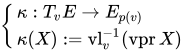
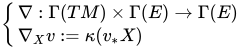
The general Ehresmann connectionTE = HE ⊕ VE on a vector bundle (E, p, M) can be characterized in terms of the connector map
induced by an Ehresmann connection is a covariant derivative on Γ(E) in the sense that
if and only if the connector map is linear with respect to the secondary vector bundle structure (TE, p∗, TM) on TE. Then the connection is called linear. Note that the connector map is automatically linear with respect to the tangent bundle structure (TE, πTE, E).









![{\displaystyle {\begin{aligned}\nabla _{X+Y}v&=\nabla _{X}v+\nabla _{Y}v\\\nabla _{\lambda X}v&=\lambda \nabla _{X}v\\\nabla _{X}(v+w)&=\nabla _{X}v+\nabla _{X}w\\\nabla _{X}(\lambda v)&=\lambda \nabla _{X}v\\\nabla _{X}(fv)&=X[f]v+f\nabla _{X}v\end{aligned}}}](https://wikimedia.org/api/rest_v1/media/math/render/svg/8f781e04dac95200da9a61a5a42954c9e42bf364)