Double tangent bundle
From Wikipedia, the free encyclopedia
In mathematics, particularly differential topology, the double tangent bundle or the second tangent bundle refers to the tangent bundle (TTM,πTTM,TM) of the total space TM of the tangent bundle (TM,πTM,M) of a smooth manifold M .[1] A note on notation: in this article, we denote projection maps by their domains, e.g., πTTM : TTM → TM. Some authors index these maps by their ranges instead, so for them, that map would be written πTM.
The second tangent bundle arises in the study of connections and second order ordinary differential equations, i.e., (semi)spray structures on smooth manifolds, and it is not to be confused with the second order jet bundle.
Since (TM,πTM,M) is a vector bundle in its own right, its tangent bundle has the secondary vector bundle structure (TTM,(πTM)*,TM), where (πTM)*:TTM→TM is the push-forward of the canonical projection πTM:TM→M. In the following we denote

and apply the associated coordinate system

on TM. Then the fibre of the secondary vector bundle structure at X∈TxM takes the form

The double tangent bundle is a double vector bundle.
The canonical flip[2] is a smooth involution j:TTM→TTM that exchanges these vector space structures in the sense that it is a vector bundle isomorphism between (TTM,πTTM,TM) and (TTM,(πTM)*,TM). In the associated coordinates on TM it reads as

The canonical flip has the property that for any f: R2 → M,
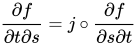
where s and t are coordinates of the standard basis of R 2. Note that both partial derivatives are functions from R2 to TTM.
This property can, in fact, be used to give an intrinsic definition of the canonical flip.[3] Indeed, there is a submersion p: J20 (R2,M) → TTM given by
![{\displaystyle p([f])={\frac {\partial f}{{\partial t}{\partial s}}}(0,0)}](https://wikimedia.org/api/rest_v1/media/math/render/svg/ee65ba161415c1ff8c8deb9cb6c0fe5c6bb2d885)
where p can be defined in the space of two-jets at zero because only depends on f up to order two at zero. We consider the application:
![{\displaystyle J:J_{0}^{2}(\mathbb {R} ^{2},M)\to J_{0}^{2}(\mathbb {R} ^{2},M)\quad /\quad J([f])=[f\circ \alpha ]}](https://wikimedia.org/api/rest_v1/media/math/render/svg/4bedad758e8fdfff08a3985f38dda69906967c1f)
where α(s,t)= (t,s). Then J is compatible with the projection p and induces the canonical flip on the quotient TTM.
Canonical tensor fields on the tangent bundle
As for any vector bundle, the tangent spaces Tξ(TxM) of the fibres TxM of the tangent bundle (TM,πTM,M) can be identified with the fibres TxM themselves. Formally this is achieved through the vertical lift, which is a natural vector space isomorphism vlξ:TxM→Vξ(TxM) defined as
![{\displaystyle (\operatorname {vl} _{\xi }X)[f]:={\frac {d}{dt}}{\Big |}_{t=0}f(x,\xi +tX),\qquad f\in C^{\infty }(TM).}](https://wikimedia.org/api/rest_v1/media/math/render/svg/a3bb2fc9b561f397c03543d9002adc578950b675)
The vertical lift can also be seen as a natural vector bundle isomorphism vl:(πTM)*TM→VTM from the pullback bundle of (TM,πTM,M) over πTM:TM→M onto the vertical tangent bundle

The vertical lift lets us define the canonical vector field

which is smooth in the slit tangent bundle TM\0. The canonical vector field can be also defined as the infinitesimal generator of the Lie-group action

Unlike the canonical vector field, which can be defined for any vector bundle, the canonical endomorphism

is special to the tangent bundle. The canonical endomorphism J satisfies
![{\displaystyle \operatorname {Ran} (J)=\operatorname {Ker} (J)=VTM,\qquad {\mathcal {L}}_{V}J=-J,\qquad [JX,JY]=J[JX,Y]+J[X,JY],}](https://wikimedia.org/api/rest_v1/media/math/render/svg/ea1180d07034414257c6deccc1a70176ab097f80)
and it is also known as the tangent structure for the following reason. If (E,p,M) is any vector bundle with the canonical vector field V and a (1,1)-tensor field J that satisfies the properties listed above, with VE in place of VTM, then the vector bundle (E,p,M) is isomorphic to the tangent bundle (TM,πTM,M) of the base manifold, and J corresponds to the tangent structure of TM in this isomorphism.
There is also a stronger result of this kind [4] which states that if N is a 2n-dimensional manifold and if there exists a (1,1)-tensor field J on N that satisfies
![{\displaystyle \operatorname {Ran} (J)=\operatorname {Ker} (J),\qquad [JX,JY]=J[JX,Y]+J[X,JY],}](https://wikimedia.org/api/rest_v1/media/math/render/svg/71d183625ced9bcfb2bee7d946fb95bd06137886)
then N is diffeomorphic to an open set of the total space of a tangent bundle of some n-dimensional manifold M, and J corresponds to the tangent structure of TM in this diffeomorphism.
In any associated coordinate system on TM the canonical vector field and the canonical endomorphism have the coordinate representations

(Semi)spray structures
A Semispray structure on a smooth manifold M is by definition a smooth vector field H on TM \0 such that JH=V. An equivalent definition is that j(H)=H, where j:TTM→TTM is the canonical flip. A semispray H is a spray, if in addition, [V,H]=H.
Spray and semispray structures are invariant versions of second order ordinary differential equations on M. The difference between spray and semispray structures is that the solution curves of sprays are invariant in positive reparametrizations[jargon] as point sets on M, whereas solution curves of semisprays typically are not.



![{\displaystyle D_{X}(fY)=X[f]Y+fD_{X}Y,\qquad \qquad \qquad f\in C^{\infty }(M)}](https://wikimedia.org/api/rest_v1/media/math/render/svg/6e0718c8bea468e3abd02aeb240124af5a647962)