Sectional density
From Wikipedia, the free encyclopedia
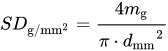
grams per square millimeter (g/mm2)
pounds per square inch (lbm/in2)
| Sectional density | |
|---|---|
 A metal nail has a small cross sectional area compared to its mass, resulting in a high sectional density. | |
| SI unit | kilograms per square meter (kg/m2) |
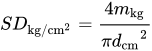
Other units | kilograms per square centimeter (kg/cm2) grams per square millimeter (g/mm2) pounds per square inch (lbm/in2) |
Sectional density (often abbreviated SD) is the ratio of an object's mass to its cross sectional area with respect to a given axis. It conveys how well an object's mass is distributed (by its shape) to overcome resistance along that axis.
Sectional density is used in gun ballistics. In this context, it is the ratio of a projectile's weight (often in either kilograms, grams, pounds or grains) to its transverse section (often in either square centimeters, square millimeters or square inches), with respect to the axis of motion. It conveys how well an object's mass is distributed (by its shape) to overcome resistance along that axis. For illustration, a nail can penetrate a target medium with its pointed end first with less force than a coin of the same mass lying flat on the target medium.
During World War II, bunker-busting Röchling shells were developed by German engineer August Coenders, based on the theory of increasing sectional density to improve penetration. Röchling shells were tested in 1942 and 1943 against the Belgian Fort d'Aubin-Neufchâteau[1] and saw very limited use during World War II.
In a general physics context, sectional density is defined as:

- SD is the sectional density
- M is the mass of the projectile
- A is the cross-sectional area
The SI derived unit for sectional density is kilograms per square meter (kg/m2). The general formula with units then becomes:
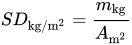
where:
- SDkg/m2 is the sectional density in kilograms per square meters
- mkg is the weight of the object in kilograms
- Am2 is the cross sectional area of the object in meters
Units conversion table
| kg/m2 | kg/cm2 | g/mm2 | lbm/in2 | |
|---|---|---|---|---|
| 1 kg/m2 = | 1 | 0.0001 | 0.001 | 0.001422334 |
| 1 kg/cm2 = | 10000 | 1 | 10 | 14.223343307 |
| 1 g/mm2 = | 1000 | 0.1 | 1 | 1.4223343307 |
| 1 lbm/in2 = | 703.069579639 | 0.070306957 | 0.703069579 | 1 |
(Values in bold face are exact.)
- 1 g/mm2 equals exactly 1000 kg/m2.
- 1 kg/cm2 equals exactly 10000 kg/m2.
- With the pound and inch legally defined as 0.45359237 kg and 0.0254 m respectively, it follows that the (mass) pounds per square inch is approximately:
- 1 lbm/in2 = 0.45359237 kg/(0.0254 m × 0.0254 m) ≈ 703.06958 kg/m2