Seepage
From Wikipedia, the free encyclopedia

In soil mechanics, seepage is the movement of water through soil. If fluid pressures in a soil deposit are uniformly increasing with depth according to , where is the depth below the water table, then hydrostatic conditions will prevail and the fluids will not be flowing through the soil. However, if the water table is sloping or there is a perched water table as indicated in the accompanying sketch, then seepage will occur. For steady state seepage, the seepage velocities are not varying with time. If the water tables are changing levels with time, or if the soil is in the process of consolidation, then steady state conditions do not apply.


Darcy's law states that the volume of flow of the pore fluid through a porous medium per unit time is proportional to the rate of change of excess fluid pressure with distance. The constant of proportionality includes the viscosity of the fluid and the intrinsic permeability of the soil. For the simple case of a horizontal tube filled with soil
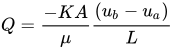
The total discharge, (having units of volume per time, e.g., ft3/s or m3/s), is proportional to the intrinsic permeability, , the cross sectional area, , and rate of pore pressure change with distance, , and inversely proportional to the dynamic viscosity of the fluid, . The negative sign is needed because fluids flow from high pressure to low pressure. So if the change in pressure is negative (in the -direction) then the flow will be positive (in the -direction). The above equation works well for a horizontal tube, but if the tube was inclined so that point b was a different elevation than point a, the equation would not work. The effect of elevation is accounted for by replacing the pore pressure by excess pore pressure, defined as:



where is the depth measured from an arbitrary elevation reference (datum). Replacing by we obtain a more general equation for flow:


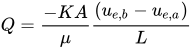
Dividing both sides of the equation by , and expressing the rate of change of excess pore pressure as a derivative, we obtain a more general equation for the apparent velocity in the x-direction:
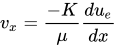
where has units of velocity and is called the Darcy velocity (or the specific discharge, filtration velocity, or superficial velocity). The pore or interstitial velocity is the average velocity of fluid molecules in the pores; it is related to the Darcy velocity and the porosity through the Dupuit-Forchheimer relationship


(Some authors use the term seepage velocity to mean the Darcy velocity,[1] while others use it to mean the pore velocity.[2])
Civil engineers predominantly work on problems that involve water and predominantly work on problems on earth (in earth's gravity). For this class of problems, civil engineers will often write Darcy's law in a much simpler form:[3][4][5]

where is the hydraulic conductivity, defined as , and is the hydraulic gradient. The hydraulic gradient is the rate of change of total head with distance. The total head, at a point is defined as the height (measured relative to the datum) to which water would rise in a piezometer at that point. The total head is related to the excess water pressure by:



and the is zero if the datum for head measurement is chosen at the same elevation as the origin for the depth, z used to calculate .

Typical values of hydraulic conductivity
Values of hydraulic conductivity, , can vary by many orders of magnitude depending on the soil type. Clays may have hydraulic conductivity as small as about , gravels may have hydraulic conductivity up to about . Layering and heterogeneity and disturbance during the sampling and testing process make the accurate measurement of soil hydraulic conductivity a very difficult problem.[3]


Flownets

Darcy's Law applies in one, two or three dimensions.[6] In two or three dimensions, steady state seepage is described by Laplace's equation. Computer programs are available to solve this equation. But traditionally two-dimensional seepage problems were solved using a graphical procedure known as flownet.[6][5][7] One set of lines in the flownet are in the direction of the water flow (flow lines), and the other set of lines are in the direction of constant total head (equipotential lines). Flownets may be used to estimate the quantity of seepage under dams and sheet piling.