Sensitivity (control systems)
From Wikipedia, the free encyclopedia
In control engineering, the sensitivity (or more precisely, the sensitivity function) of a control system measures how variations in the plant parameters affects the closed-loop transfer function. Since the controller parameters are typically matched to the process characteristics and the process may change, it is important that the controller parameters are chosen in such a way that the closed loop system is not sensitive to variations in process dynamics. Moreover, the sensitivity function is also important to analyse how disturbances affects the system.
Sensitivity function as a measure of robustness to parameter variation

Let and denote the plant and controller's transfer function in a basic closed loop control system written in the Laplace domain using unity negative feedback.


The closed-loop transfer function is given by
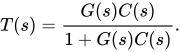
Differentiating with respect to yields


![{\displaystyle {\frac {dT}{dG}}={\frac {d}{dG}}\left[{\frac {GC}{1+GC}}\right]={\frac {C}{(1+CG)^{2}}}=S{\frac {T}{G}},}](https://wikimedia.org/api/rest_v1/media/math/render/svg/f47f4a15e8eb43b63cc1b4538e4a42f79849a395)
where is defined as the function

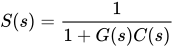
and is known as the sensitivity function. Lower values of implies that relative errors in the plant parameters has less effects in the relative error of the closed-loop transfer function.

Sensitivity function as a measure of disturbance attenuation

The sensitivity function also describes the transfer function from external disturbance to process output. In fact, assuming an additive disturbance n after the output
of the plant, the transfer functions of the closed loop system are given by

Hence, lower values of suggest further attenuation of the external disturbance. The sensitivity function tells us how the disturbances are influenced by feedback. Disturbances with frequencies such that is less than one are reduced by an amount equal to the distance to the critical point and disturbances with frequencies such that is larger than one are amplified by the feedback.[1]





