September 30 (Eastern Orthodox liturgics)
Day in the Eastern Orthodox liturgical calendar
From Wikipedia, the free encyclopedia
September 29 - Eastern Orthodox liturgical calendar - October 1

All fixed commemorations below celebrated on October 13 by Eastern Orthodox Churches on the Old Calendar.[note 1]
For September 30th, Orthodox Churches on the Old Calendar commemorate the Saints listed on September 17.
Saints
- Hieromartyr Gregory the Illuminator, Bishop and Enlightener of Greater Armenia (c. 335)[1][2][3][4][5]
- Martyrs Rhipsima[6] and Gaiana with 35 Virgin-Martyrs,[7][8] in Armenia (early 4th century)[1][2][9]
- Holy seventy (70) martyrs, with St. Rhipsima (4th century)[10][11]
- Holy 1000 martyrs, by the sword.[10][12]
- Martyr Stratonicus, by the sword.[2][10][13][14]
- Martyr Mardonius, by burning out his eyes.[2][10][14][15][note 2]
Pre-Schism Western saints
- Martyr Sophia, mother of the virgin-martyrs Faith, Hope and Charity, at Rome (c. 173)[16][17][note 3] (see also: September 17 - East)
- Martyrs Victor and Ursus, two soldiers connected with the Theban Legion and venerated in Soleure in Switzerland (286)[16][note 4][note 5]
- Saint Antoninus, a soldier of the Theban Legion, martyred on the banks of the Trebbia near Piacenza in Italy (3rd century)[16][17][note 6]
- Saint Leopardus, a servant or slave in the household of Julian the Apostate, likely martyred in Rome (362)[16][note 7]
- Blessed Jerome (Hieronymus) of Stridonium (420)[1][16][19][note 8][note 9] (see also: June 15 - East)
- Saint Midan (Nidan), a saint on Anglesey in Wales (c. 610)[16]
- Saint Honorius, Archbishop of Canterbury, Confessor (653)[1][10][14][16][17][20][21][note 10][note 11]
- Saint Enghenedl, a church in Anglesey in Wales was dedicated to him (7th century)[16]
- Saint Laurus (Lery), born in Wales, he went to Brittany and founded the monastery later called after him, Saint-Léry, on the River Doneff (7th century)[16]
- Martyr-hermits Tancred, Torthred, and Tova, three Anglo-Saxon siblings of Thorney.[14][16][note 12]
Post-Schism Orthodox saints
- Saint Michael, Great Prince of Tver (1318)[1][14]
- Venerable Gregory, founder of Pelshma Monastery in Vologda, Wonderworker (1442)[1][2][7][10][14][23][24][note 13]
- Saint Meletius I Pegas, Patriarch of Alexandria (1601)[1][14][note 14] (see also: September 13 - Greek)
New martyrs and confessors
- New Hieromartyr Prokopius Popov, Priest (1918)[7][14]
- New Hieromartyrs (1937):
- Peter Solovyov, Viacheslav (Wenceslaus) Zankov, Peter Pushkinsky, Symeon Lileev, Basil Guriev, Alexander Orlov, Priests;[7][14]
- Seraphim Vasilenko, Deacon;[7][14]
- Virgin-martyr Alexandra (Chervyakova), Schemanun, of Moscow (1937)[1][7][14]
- Martyrs Alexis Serebrennikov and Matthew Solovyov;[7][14]
- Virgin-martyr Apollinaria Tupitsyna.[7][14]
Other commemorations
Icon gallery
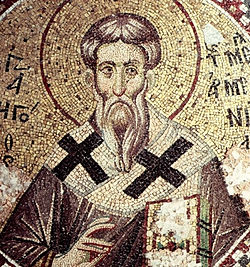 Hieromartyr Gregory the Illuminator, Bishop and Enlightener of Greater Armenia.
 Hieromartyr Gregory the Illuminator, Bishop and Enlightener of Greater Armenia.
 Tombstone of St. Rhipsima.
 Martyrs Rhipsima and Gaiana.
 St. Sophia the Martyr.

 Venerable Gregory, founder of Pelshma Monastery in Vologda.
 Michael, First Metropolitan of Kiev.


.jpg)

.jpg)


.jpg)
Notes
- The notation Old Style or (OS) is sometimes used to indicate a date in the Julian Calendar (which is used by churches on the "Old Calendar").
The notation New Style or (NS), indicates a date in the Revised Julian calendar (which is used by churches on the "New Calendar"). - There is also a martyr named Mardonius commemorated on December 28. It is not impossible that they are the same individual.
- The mother of the virgin-martyrs Faith, Hope and Charity who were martyred in Rome under Hadrian. Three days later, while praying at their tomb, Sophia also reposed, martyred in her soul.
- "At Soleure, in Switzerland, in the time of the emperor Maximian, the passion of the holy martyrs Victor and Ursus, of the glorius Theban legion, who were subjected to horrid tortures; but a heavenly light shining over them, and causing the executioners to fall to the ground, they were delivered. Being then cast into the fire without sustaining any injury, they finally perished by the sword."[17]
- SAINTS VICTOR and Ursus were, according to S. Eucherius of Lyons, two Christian soldiers belonging to the Theban legion, cohorts or maniples of which were scattered along the German frontier. They were called on to sacrifice, and when they refused they were beheaded at Soleure, of which city they are now regarded as the patrons. As they were dying a sudden dazzling sunbeam is said to have fallen on and glorified the martyrs."[18]
- His blood, kept in a phial, has the same miraculous properties as that of St Januarius.
- Eusebius Hieronymus Sophronius was born at Stridon in Dalmatia. He studied in Rome, travelled in Italy and Gaul, lived as a hermit in Palestine and then returned to Rome where he was ordained. He finally went back to Palestine and settled in Bethlehem. He spent the rest of his life translating and commenting on the Bible. The Orthodox Church accords him the title of Blessed.
- "IN Bethlehem of Juda, the decease of St. Jerome, priest and Doctor of the Church, who, excelling in all kinds of learning, imitated the life of the most approved monks, and disposed of many monstrous heresies with the sword of his doctrine. Having at length reached a very advanced age, he rested in peace, and was buried near the manger of our Lord. His body was afterwards conveyed to Rome, and deposited in the basilica of St. Mary the Greater."[17]
- "Honorius was a disciple of S. Gregory the Great, and was sent by him to Britain along with S. Augustine. He succeeded S. Justus in the see of Canterbury. He is said by some to have been ordained by S. Paulinus of York, at Lincoln, and Honorius I. the Pope, sent him the pall in A.D. 634. When King Edwin fell in the battle of Hatfield (11th October, 633), and Northumbria was ravaged by the ferocious Cadwallon, who sought, as Bede says, to extirpate from the soil of Britain the English race, S. Paulinus fled by sea, taking with him the gentle Ethelburga, the widow of King Edwin, with the daughter and the two youngest sons whom she had borne to Edwin. He placed them in safety with her brother, the King of Kent, and then was invested with the bishopric of Rochester by the King and Archbishop Honorius."[22]
- Two hermits and an anchoress martyred by the Danes at Thorney in England.
- See: (in Russian) Григорий Пельшемский. Википедии. (Russian Wikipedia).
- "St Meletiy has been formally included in the list of All Saints of Galicia for his activity on behalf of Ukrainian Orthodox, especially for his support of the Orthodox at the time of the Union of Brest."[25]
- See: (in Russian) Собор Галицких святых. Википедии. (Russian Wikipedia).
- See: (in Russian) Серафим (Загоровский). Википедии. (Russian Wikipedia).