September 6 (Eastern Orthodox liturgics)
Day in the Eastern Orthodox liturgical calendar
From Wikipedia, the free encyclopedia
September 5 – Eastern Orthodox liturgical calendar – September 7

All fixed commemorations below are celebrated on September 19 by Eastern Orthodox Churches on the Old Calendar.[note 1]
For September 6th, Orthodox Churches on the Old Calendar commemorate the Saints listed on August 24.
Saints
- Martyrs Romulus and 11,000 others, in Armenia (c. 107-115)[1][2][3]
- Martyrs Cyriacus, Faustus, Abibus, and 11 others, at Alexandria (250)[1][4][note 2][note 3]
- Martyrs Calodote,[10] Macarius, Andrew, Cyriacus, Dionysius, Andrew the Soldier,[11] Andropelagia, Thecla,[12] Theoctistus,[13] and Sarapabon the Senator,[14] in Egypt (256)[1][15]
- Hieromartyr Cyril, Bishop of Gortyna on Crete (c. 303)[1][15][16] (see also: June 14, July 9)
- Martyr Eudoxius, and with him Martyrs Zeno, Macarius, and 1,104 soldiers, in Melitene (311-312)[1][2][15][17]
- Saint Archippus of Hierapolis (4th century)[1][15][18]
- Saint David of Hermopolis in Egypt (6th century)[1][15][19]
Pre-Schism Western saints
- Saints Augustine, Sanctian and Beata, born in Spain, martyred near Sens in France, where they were venerated (273)[20]
- Saint Petronius, Bishop of Verona and Confessor (c. 450)[9][20]
- Saint Arator, fourth Bishop of Verdun in France (c. 460)[20]
- Saint Maccallin (Macallan, Macculin Dus), Bishop of Lusk in Ireland, also venerated in Scotland (c. 497)[20]
- Saints Donatian, Praesidius, Mansuetus, Germanus, Fusculus and Laetus, driven out of Africa into exile by Huneric the Arian King of the Vandals (5th century)[20][note 4]
- Saint Eleutherius, Abbot of St Mark's Abbey in Spoleto, then a monk at San Gregorio Magno al Celio in Rome (c. 590)[20][note 5][note 6]
- Saint Faustus, Abbot of the monastery of Santa Lucy in Syracuse in Sicily (c. 607)[20][note 7]
- Saint Cagnoald (Chainoaldus, Cagnou), brother of St Faro and St Burgundofara, he became a monk at Luxeuil Abbey in France, and later the sixth Bishop of Laon (c. 635)[20]
- Saint Beya (Bega, Begh, Bee), Virgin, first Abbess of Copeland in Cumbria (7th century)[1][15][20][note 8]
- Saints Felix and Augebert, missionaries killed by pagans in Champagne (7th century)[20][note 9]
- Saint Magnus of Füssen (Magnoaldus, Maginold, Mang), Enlightener of the Allgäu region of Germany (750-772)[1][15][note 10]
Post-Schism Orthodox saints
New martyrs and confessors
- New Hieromartyr Maximus Sandovich, Priest, of Lemkovina, in the Carpathian Mountains (1914)[21][22][note 11]
- New Hieromartyr Demetrius Spassky, Priest (1918)[15][24][25]
- New Hieromartyrs John Pavlovsky[26] and Vsevolod Poteminsky,[27] Priests (1937)[15][24]
- New Hieromartyr Constantine Bogoslovsky, Priest (1937)[15][22][28]
Other commemorations
- Commemoration of the Miracle of the Archangel Michael at Colossae (Chonae) (4th century)[1][15][24][29][30][31]
- Synaxis of the Archangel Michael at Nimborio (the commercial port) of Symi island, Greece.[32][note 12]
- Synaxis of the Archangel Michael of Perimpliotis, on Symi island, Greece.[33][note 13]
- Second Consecration of the Church of the Theotokos "in the home of St. Irene (or of St. Anne)".[30][34][note 14]
- Icon of the Theotokos of Kiev-Bratsk (1654)[15][24][28][30][35] (see also: May 10)
- Icon of the Theotokos Arapet (Arabian).[15][24][36][37][note 15]
- Repose of Ivan Yakovlevich Koreisha, Fool-for-Christ, of Moscow (1861)[1]
- Repose of Archimandrite Paisius the New of Mount Athos (1871)[1]
Icon gallery
 Miracle of the Archangel Michael at Colossae (Chonae).
 Martyrs Romulus, and Eudoxius, and 1,104 soldiers, in Melitene.
 Faustus the Presbyter, Abibas the Deacon, Cyriacus and 11 other martyrs.
 New Hieromartyr Maxim Sandovich, Priest, of Lemkovina.
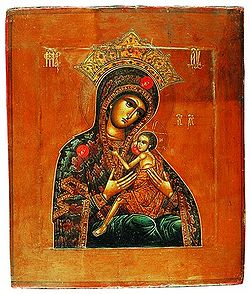 Icon of the Theotokos Arapet (Arapetskaya, Arabian).
.jpg)

_Abibas_the_Deacon_and_other_(Menologion_of_Basil_II).jpg)


Notes
- The notation Old Style or (OS) is sometimes used to indicate a date in the Julian Calendar (which is used by churches on the "Old Calendar").
The notation New Style or (NS), indicates a date in the Revised Julian calendar (which is used by churches on the "New Calendar"). - "In Africa, in the persecution of the Vandals, the holy bishops Donatian, Praesidius, Mansuetus, Germanus, and Fusculus, who were most cruelly scourged and sent into exile, by order of the Arian king Hunneric, because they proclaimed the Catholic truth. Among them was one named Laetus, also a bishop, a courageous and most learned man, who was burned alive after a long imprisonment in a loathsome dungeon."[9]
- He is mentioned several times by St Gregory the Great as a wonderworker. He was Abbot of St Mark's in Spoleto in Italy, which he left for St Gregory's own monastery in Rome, where he lived as a monk for many years.
- His disciple was Zosimus, the future Bishop of Syracuse.
- A holy virgin from Ireland who founded a convent at what is now St Bees Head in Cumberland. The village of Kilbees in Scotland was also named after her.
- Two slaves from England sold in France and ransomed by St Gregory the Great, who asked that they be taken to a monastery to be prepared as missionaries in England. Felix was ordained priest and Augebert deacon, but they were killed by pagans in Champagne before they could undertake their mission.
- Born in Ireland, he preached with Sts Columbanus and Gall. He founded the Monastery of Füssen in Bavaria in Germany.
- The meaning of the Greek is unclear and no further details are given in the Synaxarion:
- (in Greek) :Ἐγκαίνια Ναοῦ Ὑπεραγίας Θεοτόκου εἰς τὸ Δεύτερον ἐν τῷ οἴκῳ τῆς Ἁγίας Εἰρήνης (κατ’ ἄλλους Ἁγίας Ἄννης)".
- See: (in Russian) Арапетская икона Божией Матери. Википедии. (Russian Wikipedia).