Sharp series
From Wikipedia, the free encyclopedia
The sharp series is a series of spectral lines in the atomic emission spectrum caused when electrons descend from higher-energy s orbitals of an atom to the lowest available p orbital. The spectral lines include some in the visible light, and they extend into the ultraviolet. The lines get closer and closer together as the frequency increases never exceeding the series limit. The sharp series was important in the development of the understanding of electron shells and subshells in atoms. The sharp series has given the letter s to the s atomic orbital or subshell.
The sharp series has a limit given by
![{\displaystyle v={\frac {R}{\left[2+p\right]^{2}}}-{\frac {R}{\left[m+s\right]^{2}}}{\text{ with }}m=2,3,4,5,6,...}](https://wikimedia.org/api/rest_v1/media/math/render/svg/2bcad1bf09856f36f573f78a44ebb6fb0b616e34)
The series is caused by transitions to the lowest P state from higher energy S orbitals. One terminology to identify the lines is: 1P-mS[1] But note that 1P just means the lowest P state in an atom and that the modern designation would start at 2P, and is larger for higher atomic numbered atoms.
The terms can have different designations, mS for single line systems, mσ for doublets and ms for triplets.[2]
Since the P state is not the lowest energy level for the alkali atom (the S is) the sharp series will not show up as absorption in a cool gas, however it shows up as emission lines. The Rydberg correction is largest for the S term as the electron penetrates the inner core of electrons more.
The limit for the series corresponds to electron emission, where the electron has so much energy it escapes the atom. Even though the series is called sharp, the lines may not be sharp.[3]
In alkali metals the P terms are split and . This causes the spectral lines to be doublets, with a constant spacing between the two parts of the double line.


The sharp series used to be called the second subordinate series, with the diffuse series being the first subordinate, both being subordinate to the principal series.[2]
Laws for alkali metals
The sharp series limit is the same as the diffuse series limit. In the late 1800s these two were termed supplementary series.
In 1896 Arthur Schuster stated his law: "If we subtract the frequency of the fundamental vibration from the convergence frequency of the principal series, we obtain the convergence frequency of the supplementary series".[5] But in the next issue of the journal he realised that Rydberg had published the idea a few months earlier.[6]
Rydberg Schuster Law: Using wave numbers, the difference between the sharp and diffuse series limits and principle series limit is the same as the first transition in the principal series.
- This difference is the lowest P level.[7]
Runge's Law: Using wave numbers the difference between the sharp series limit and fundamental series limit is the same as the first transition in the diffuse series.
- This difference is the lowest D level energy.[7]
Sodium

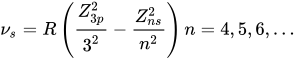
The sharp series has wave numbers given by:
The sodium diffuse series has wave numbers given by:
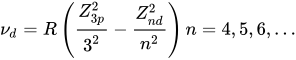
when n tends to infinity the diffuse and sharp series end up with the same limit.[8]
| sodium sharp series[9] | ||
|---|---|---|
| transition | wavelength 1 Å | wavelength 2 Å |
| 3P-4S | 11403.8 | 11381.5 |
| 3P-5S | 6160.75 | 6154.23 |
| 3P-6S | 5158.84 | 5153.40 |
| 3P-7S | 4751.82 | 4747.94 |
| 3P-8S | 4545.19 | 4541.63 |
| 3P-9S | 4423.35 | 4419.89 |
| 3P-10S | 4344.74 | 4341.49 |
| 3P-11S | 4291.01 | 4287.84 |
| 3P-12S | 4252.52 | 4249.41 |
| 3P-13S | 4223.2 | 4220.2 |
| 3P-14S | 4201.0 | 4198.0 |
Potassium
| potassium sharp series[10] | ||
|---|---|---|
| transition | wavelength 1 Å | wavelength 2 Å |
| 4P-5S | 12522.1 | 12432.2 |
| 4P-6S | 6933.8 | 6911.1 |
| 4P-7S | 5801.8 | 5782.4 |
| 4P-8S | 5339.8 | 5323.4 |
| 4P-9S | 5099.2 | 5084.3 |
| 4P-10S | 4956.1 | 4942.0 |
| 4P-11S | 4863.6 | 4850.0 |
| 4P-12S | 4800.2 | 4786.9 |
| 4P-13S | 4754.6 | 4741.6 |
Alkaline earths
A sharp series of triplet lines is designated by series letter s and formula 1p-ms. The sharp series of singlet lines has series letter S and formula 1P-mS.[3]
Calcium
Calcium has a sharp series of triplets and a sharp series of singlets.[11]