Sigma heat
From Wikipedia, the free encyclopedia
Sigma heat, denoted , is a measure of the specific energy of humid air. It is used in the field of mining engineering for calculations relating to the temperature regulation of mine air. Sigma heat is sometimes called total heat,[1] although total heat may instead mean enthalpy.[2]

Sigma heat is the energy which would be extracted from a unit mass of humid air if it were cooled to a certain reference temperature under constant pressure while simultaneously removing any condensation formed during the process. Because sigma heat assumes that condensation will be removed, any energy which would be extracted by cooling the water vapor below its condensation point does not count towards sigma heat.[3] The reference temperature is usually 0 °F (−18 °C), although 32 °F (0 °C) is sometimes used as well.[1]
Assuming a reference temperature of 0°F, the following formula may be used under standard temperature ranges and pressure:[note 1]

- where
- is the sigma heat of the air (in BTU/lb),
- is the dry-bulb temperature of the air (in °F), and
- is the specific humidity of the air (unitless).


The equivalent metric formula:

- where
- is the sigma heat of the air (in kJ/kg),
- is the dry-bulb temperature of the air (in °C), and
- is the specific humidity of the air (unitless) sometimes expressed as kg/kg.
Comparison with enthalpy
Sigma heat is not the same as the enthalpy of the humid air above the reference temperature. (Enthalpy is sometimes called total heat[2] or true total heat[1]) Unlike sigma heat, enthalpy does include the energy which would be extracted in cooling the condensed water vapor all the way to the reference temperature. Essentially, enthalpy assumes that all components of the system must be cooled during the cooling process, whereas sigma heat assumes that some of those components (liquid water) are removed part way through the process. Nevertheless, some writers mistakenly use the term enthalpy when they actually mean sigma heat, creating some confusion.[3]
Assuming a reference temperature of 0°F, the relationship between enthalpy and sigma heat may be shown mathematically as:
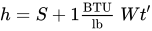
- where
- is the specific enthalpy of the air above its reference temperature,
- is the sigma heat of the air (in BTU/lb),
- is the specific humidity of the air (unitless), and
- is the wet bulb temperature (in °F).
- (Standard temperature ranges are assumed.)

