Let  be the gas density,
  the velocity,
  the pressure and
 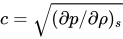 the speed of sound. In isentropic flows, entropy
  is constant and if the initial state of the gas is homogenous, then entropy is a constant everywhere at all times and therefore the pressure is a function only of , i.e.,
  In simple waves, all dependent variables are just function of any one of the dependent variables (this is certainly the case in one-dimensional sound waves) and therefore we can assume the velocity to be also a function only of . i.e.,
  This latter property is the cause of origin of the name simple wave, although the wave is nonlinear.
From the one-dimensional Euler equations, we have
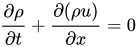
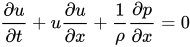
which, because  , can be written as
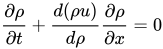
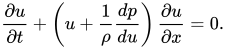
Further, since (remember that the time derivative of a function  integrated along a curve
  is given by
  )
)

the two equations lead to

However, since determines and therefore the above derivatives must be equal so that  . Thus, we obtain
 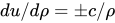 , whence
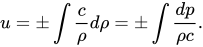
This equation provides the required relation or,  or,
or,  etc. The above equation is just a statement that either the
  or the
  Riemann invariant is constant.
Thus, we obtain
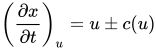 ,
,
which upon integration becomes
![{\displaystyle x=t[u\pm c(u)]+f(u)}](https://wikimedia.org/api/rest_v1/media/math/render/svg/8b1ccaeeaad0915c56c4a81bfda5a18db0f78681)
where  is an arbitrary function. This equation indicates that the characteristics in the
  -
- plane are just straight lines. When
  and when consequently length scale and time scale associated with the initial function disappears, the problem is self-similar and the solution depends only on the ratio
  . This particular case is referred as the centred simple wave.




