Simplicial depth
From Wikipedia, the free encyclopedia

In robust statistics and computational geometry, simplicial depth is a measure of central tendency determined by the simplices that contain a given point. For the Euclidean plane, it counts the number of triangles of sample points that contain a given point.
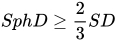
The simplicial depth of a point in -dimensional Euclidean space, with respect to a set of sample points in that space, is the number of -dimensional simplices (the convex hulls of sets of sample points) that contain . The same notion can be generalized to any probability distribution on points of the space, not just the empirical distribution given by a set of sample points, by defining the depth to be the probability that a randomly chosen -tuple of points has a convex hull that contains . This probability can be calculated, from the number of simplices that contain , by dividing by where is the number of sample points.[L88][L90]


Under the standard definition of simplicial depth, the simplices that have on their boundaries count equally much as the simplices with in their interiors. In order to avoid some problematic behavior of this definition, Burr, Rafalin & Souvaine (2004) proposed a modified definition of simplicial depth, in which the simplices with on their boundaries count only half as much. Equivalently, their definition is the average of the number of open simplices and the number of closed simplices that contain .[BRS]