Sinharaja Forest Reserve
UNESCO World Heritage Site
From Wikipedia, the free encyclopedia
Sinharaja Forest Reserve is the last virgin Rainforest[1] left in Sri Lanka. Home to many rare endemic flora and fauna, it has been designated a World Heritage Site by UNESCO.[2]
.jpg)
| Sinharaja Forest Reserve | |
|---|---|
View of Sinharaja Forest Reserve with tea garden | |
 Interactive map of Sinharaja Forest Reserve | |
| Location | Sabaragamuwa and Southern Provinces, Sri Lanka |
| Nearest city | Rakwana |
| Coordinates | 6°25′00″N 80°30′00″E |
| Area | 88.64 km2 (34.22 sq mi) |
| Established | April, 1978 |
| Governing body | Department of Forest Conservation |
| Criteria | Natural: ix, x |
| Reference | 405 |
| Inscription | 1988 (12th Session) |
Formed during the Jurassic period (from 200 to 145 million years ago), Sinharaja forest is the most dense rain forest in Asia.[3]
Features
Over 60% of the trees are endemic, many of them considered rare. It is home to 95% endemic birds.

Of Sri Lanka's 26 endemic birds, the 20 rainforest species all occur here, including the elusive red-faced malkoha, green-billed coucal and Sri Lanka blue magpie.
Reptiles include the endemic green pit viper, hump-nosed viper, a large variety of amphibians (especially tree frogs) and invertebrates include the endemic Sri Lankan birdwing butterfly and leeches.
Geography
Location
Sinharaja Forest Reserve covers most of the Kalu Ganga basin and a small part of the northern Gin Ganga. Most of the forest (60%) is contained within the borders of Rathnapura District. The other parts include Galle District with 20% and Kaluthara District with 20%.[4]
Natural
The rainforest likely formed during the Jurassic period (from 200 million years to 145 million years ago). This forest encompasses an area of 36,000 hectares (88,960 acres/360 km2).[5]
Human activity
The reserve is well-integrated with the local population who live in some dozens of villages dotted along the border. The locals collect herbal medicine, edible fruits, nuts, mushrooms, other non-timber forest products including bees honey and a sugary sap collected from a local palm species of the genus Caryota.
In 2013, UNESCO requested to halt the widening of the ancient road linking Lankagama area to Deniyaya along a 1-km jungle patch inside the protected area after a complaint from the Centre for Environmental and Nature Studies of Sri Lanka. A group of environmentalists carried out a big social media campaign and asked the authorities to stop
Mr. Martin Wijesinhe was one of the most significant people in Sri Lanka in connection to the Sinharaja[6] , unofficial guardian and caretaker of it since the 1950s till his death in 2021.[7]
Tourism
The Sinharaja Forest Reserve is open to the public and accessible to tourists through four main entrances: Weddagala (north-west), Rakwana (north-east), Neluwa (south-west), and Deniyaya–Mederipitiya(South-East).
In accordance with conservation regulations, all visitors are required to enter the forest accompanied by a licensed guide. A variety of guided hiking tours are available, led by certified Sri Lankan tour guides, offering insights into the forest’s rich biodiversity and ecological significance.[8]
Endemic Mammals
Source:[9]
- Sri Lankan elephant (Elephas maximus maximus)
- Sri Lankan leopard (Panthera pardus kotiya)
- Sri Lankan deer (Rusa unicolor unicolor)
- Sri Lankan spotted chevrotain (Moschiola meminna)
- Sri Lankan jackal (Canis aureus naria)
- Toque macaque (Macaca sinica)
- Red slender loris (Loris tardigradus)
- Purple-faced langur (Semnopithecus vetulus)
- Sinharaja shrew (Crocidura hikmiya)
- Golden palm civet (Paradoxurus zeylonensis)
- Paradoxurus aureus
- Golden dry-zone palm civet (Paradoxurus stenocephalus)
- Sri Lankan brown palm civet (Paradoxurus montanus)
- Yellow-striped chevrotain (Moschiola kathygre)
Gallery
Source:[10]
 A waterfall in Sinharaja Rainforest
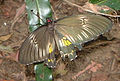 Common Birdwing
 Yellow-browed bulbul
 Purple-faced langur with baby
 A stream in the reserve
 The high tree canopy in the reserve