Smale's problems
18 mathematical problems stated in 1998
From Wikipedia, the free encyclopedia
Smale's problems is a list of eighteen unsolved problems in mathematics proposed by Steve Smale in 1998[1] and republished in 1999.[2] Smale composed this list in reply to a request from Vladimir Arnold, then vice-president of the International Mathematical Union, who asked several mathematicians to propose a list of problems for the 21st century. Arnold's inspiration came from the list of Hilbert's problems that had been published at the beginning of the 20th century.
Table of problems
 ...
...| Problem | Brief explanation | Status | Year Solved |
|---|---|---|---|
| 1st | Riemann hypothesis: The real part of every non-trivial zero of the Riemann zeta function is 1/2. (see also Hilbert's eighth problem) | Unresolved. | – |
| 2nd | Poincaré conjecture: Every simply connected, closed 3-manifold is homeomorphic to the 3-sphere. | Resolved. Result: Yes, Proved by Grigori Perelman using Ricci flow.[3][4][5] | 2003 |
| 3rd | P versus NP problem: For all problems for which an algorithm can verify a given solution in polynomial time, can an algorithm also find that solution in polynomial time? | Unresolved. | – |
| 4th | Shub–Smale tau-conjecture:[6][7] let and by denote the minimal number of steps required to generate using addition, subtraction or multiplication from and .
Is there a constant independent on such that number of integer zeros of is bounded by ? |
Unresolved. | – |
| 5th | Can one decide if a Diophantine equation ƒ(x, y) = 0 (input ƒ ∈ [u, v]) has an integer solution, (x, y), in time (2s)c for some universal constant c? That is, can the problem be decided in exponential time? | Unresolved. | – |
| 6th | Is the number of relative equilibria (central configurations) finite in the n-body problem of celestial mechanics, for any choice of positive real numbers m1, ..., mn as the masses? | Unresolved. Partial results include proof for almost all systems of five bodies by A. Albouy and V. Kaloshin.[8] | – |
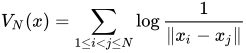
| 7th | Algorithm for finding set of such that the function: is minimized for a distribution of N points on a 2-sphere. This is related to the Thomson problem. | Unresolved. | – |
| 8th | Develop dynamical mathematical model of market equilibrium to include price adjustments. The excess demand function in such model is required to satisfy economic-justified conditions:
The model may incorporate other economic variables along with the prices but it should be compatible with existing general equilibrium theory. |
Gjerstad (2013)[9] extends the deterministic model of price adjustment by Hahn and Negishi (1962)[10] to a stochastic model and shows that when the stochastic model is linearized around the equilibrium the result is the autoregressive price adjustment model used in applied econometrics. He then tests the model with price adjustment data from a general equilibrium experiment. The model performs well in a general equilibrium experiment with two commodities. Lindgren (2022)[11] provides a dynamic programming model for general equilibrium with price adjustments, where price dynamics are given by a Hamilton-Jacobi-Bellman partial differerential equation. Good Lyapunov stability conditions are provided as well. | 2013, 2022? |
| 9th | The linear programming problem: Find a strongly-polynomial time algorithm which for given matrix A ∈ Rm×n and b ∈ Rm decides whether there exists x ∈ Rn with Ax ≥ b. | Unresolved. | – |
| 10th | Pugh's closing lemma (higher order of smoothness) | Unresolved. Partial results include proof for Hamiltonian diffeomorphisms of closed surfaces by M. Asaoka and K. Irie.[12] | – |
| 11th | Is one-dimensional dynamics generally hyperbolic? (a) Can a complex polynomial T be approximated by one of the same degree with the property that every critical point tends to a periodic sink under iteration? (b) Can a smooth map T : [0,1] → [0,1] be C r approximated by one which is hyperbolic, for all r > 1? |
(a) Unresolved, even in the simplest parameter space of polynomials, like the Mandelbrot set. | – |
| (b) Resolved. Proved by Kozlovski, Shen and van Strien.[13] | 2007 | ||
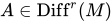
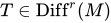
| 12th | For a closed manifold and any let be the topological group of diffeomorphisms of onto itself. Given arbitrary , is it possible to approximate it arbitrary well by such that it commutes only with its iterates?
In other words, is the subset of all diffeomorphisms whose centralizers are trivial dense in ? |
Unresolved. Partial results include proof for C1 topology by Christian Bonatti, Sylvain Crovisier and Amie Wilkinson[14]. Still open in the C r topology for r > 1. | – |
| 13th | Hilbert's 16th problem: Describe relative positions of ovals originating from a real algebraic curve and as limit cycles of a polynomial vector field on the plane. | Unresolved. Exact description of position of components for real algebraic curves is an open problem, even for small degrees like 8. For polynomial vector fields, partial results include proof that they have finitely many limit cycles, but no effective bound is known. | – |
| 14th | Do the properties of the Lorenz attractor exhibit that of a strange attractor? | Resolved. Result: Yes, solved by Warwick Tucker using a computer-assisted proof combined with normal form techniques.[15] | 2002 |
| 15th | Do the Navier–Stokes equations in R3 always have a unique smooth solution that extends for all time? | On 8 September 2026, OpenAI published anonymized paper with a proposed solution to the Navier–Stokes existence and smoothness problem, claiming to prove finite-time breakdown for the forced three-dimensional incompressible Navier–Stokes equations on R3.[16] The proof wasn't published in any peer-review source and did not passed independent review yet. | 2026? |
| 16th | Jacobian conjecture: If F : kN → kN is regular mapping and the Jacobian determinant of F is a non-zero constant and k has characteristic 0, then F has an inverse function G : kN → kN that is also regular. | For , a counterexample was given by Levent Alpöge, who claimed using the large language model assistance.[17][18] This counterexample induces counterexamples for .
It is unsure if this problem should be thought as resolved completely, since the case remains open,[19] with specialist literature distinguishing its status from the case .[20][21][22][23][24] |
2026? |
| 17th | Solving polynomial equations in polynomial time in the average case | Resolved. C. Beltrán and L. M. Pardo found two uniform probabilistic algorithms (average Las Vegas algorithm) for Smale's 17th problem[25][26][27] F. Cucker and P. Bürgisser made the smoothed analysis of a probabilistic algorithm à la Beltrán-Pardo and then exhibited a deterministic algorithm running in time .[28] Finally, P. Lairez found an alternative method to de-randomize the algorithm à la Beltrán-Pardo and thus found a deterministic algorithm which runs in average polynomial time.[29] All these works follow Shub and Smale's foundational work (the "Bezout series") started in [30] |
2008–2016 |
| 18th | Limits of intelligence (it talks about the fundamental problems of intelligence and learning, both from the human and machine side)[31] | Recent results include claims about the unlimited nature of human intelligence[32] and limitations on neural-network-based artificial intelligence[33]. There is no consensus whether problem is resolved. | – |






In later versions, Smale also listed three additional problems, "that don't seem important enough to merit a place on our main list, but it would still be nice to solve them:"[34][35]
- Mean value problem
- Is the three-sphere a minimal set (Gottschalk's conjecture)?
- Is an Anosov diffeomorphism of a compact manifold topologically the same as the Lie group model of John Franks?

