Small sets were introduced by Michael Shub and Benjamin Weiss while investigating the question "can one always lower topological entropy?" Quoting from their article:[1]
"For measure theoretic entropy, it is well known and quite easy to see that a positive entropy transformation always has factors of smaller entropy. Indeed the factor generated by a two-set partition with one of the sets having very small measure will always have small entropy. It is our purpose here to treat the analogous question for topological entropy... We will exclude the trivial factor, where it reduces to one point."
Recall that a system  is called a factor of
  , alternatively is called an extension of , if there exists a continuous surjective mapping
  which is eqvuivariant, i.e.
  for all
  .
.
Thus Shub and Weiss asked: Given a system and  , can one find a non-trivial factor so that
 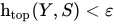 ?
?
Recall that a system is called minimal if it has no proper non-empty closed  -invariant subsets. It is called infinite if
  .
.
Lindenstrauss introduced SBP and proved:[2]
Theorem: Let be an extension of an infinite minimal system. The following are equivalent:
- has the small-boundary property.
 , where
  denotes mean dimension.
- For every ,
 , there exists a factor
  so
so  and
and  .
.
 where
where 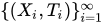 is an inverse limit of systems with finite topological entropy
  for all
  .
.
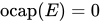
Later this theorem was generalized to the context of several commuting transformations by Gutman, Lindenstrauss and Tsukamoto.[3]






![{\displaystyle X=[0,1]^{\mathbb {Z} }}](https://wikimedia.org/api/rest_v1/media/math/render/svg/45decd15647fd72d387ea6a03752af73e9f16a19)

