Smilax ornata
Species of flowering plant in the family Smilacaceae
From Wikipedia, the free encyclopedia
Smilax ornata is a perennial trailing vine with prickly stems that is native to Mexico and Central America.[3] Common names include sarsaparilla,[4] Honduran sarsaparilla,[4] and Jamaican sarsaparilla.[4]

| Smilax ornata | |
|---|---|
| |
Scientific classification  | |
| Kingdom: | Plantae |
| Clade: | Embryophytes |
| Clade: | Tracheophytes |
| Clade: | Angiosperms |
| Clade: | Monocots |
| Order: | Liliales |
| Family: | Smilacaceae |
| Genus: | Smilax |
| Species: | S. ornata |
| Binomial name | |
| Smilax ornata | |
| Synonyms[1] | |
| |
It is known in Spanish as zarzaparrilla, which is derived from the words zarza meaning "bramble" (from Basque sartzia "bramble"), and parrilla, meaning "little grape vine".[5][6][7][8][9]
Uses
Food
Smilax ornata is used as the basis for a soft drink known as sarsaparilla. It is also a primary ingredient in old fashioned-style licorice,[10][failed verification] in conjunction with sassafras,[11] which was more widely available prior to studies of its potential health risks.[citation needed]
Traditional medicine
Smilax ornata was considered by Native Americans to have medicinal properties, and was a popular European treatment for syphilis when it was introduced from the New World.[12] From 1820 to 1910, it was registered in the U.S. Pharmacopoeia as a treatment for syphilis.[citation needed]
Chemical constituents gallery
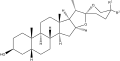 Triterpenes, a constituent of sarsaparilla
 Sarsaparilloside, a constituent of sarsaparilla
 Sarsaparilla R1, a constituent of sarsaparilla
 Sarsaparilla R2, a constituent of sarsaparilla
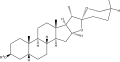 Parillin, a constituent of sarsaparilla


See also
- Hemidesmus indicus, Indian sarsaparilla
- Aralia nudicaulis, wild sarsaparilla or false sarsaparilla
- Sweet sarsaparilla (Smilax glyciphylla), a vine native to eastern Australia[13]
