Soleymaniyeh Palace
Palace in Karaj, Iran
From Wikipedia, the free encyclopedia
The Soleymaniyeh Palace (Persian: کاخ سلیمانیه, romanized: Kākh-e Soleymaniyeh) is a Qajar era royal residence in Karaj, Iran. It is notable for its paintings depicting Agha Mohammad Khan Qajar's brothers and Fath-Ali Shah Qajar and his sons.[1]
.jpg)
| Soleymaniyeh Palace | |
|---|---|
کاخ سلیمانیه | |
Northern facade, 2024 | |
 Interactive map of the Soleymaniyeh Palace area | |
General information | |
| Type | Royal residence |
Architectural style | Qajar architecture |
| Location | Karaj, Iran |
| Inaugurated | 1811–1812 |
| Design and construction | |
| Architect | Hajji Mohammad Hossein Isfahani |
History
The palace, designed by the architect Hajji Mohammad Hossein Isfahani, was constructed by the order of Fath-Ali Shah in a large garden near the Karaj river.[1][2]
There are two stories regarding the name of the building. The more probable one states that the palace was built on the occasion of the birth of the Shah's 34th son, named Soleiman Mirza. Soleiman Miza is shown as a child near the throne in one of the paintings.[1][3][4][5][2] However, Gaspard Drouville, a Frenchman who was in Iran at the time, reports that a son of Fath-Ali Shah, Mohammad-Ali Mirza Dowlatshah, was unhappy of Abbas Mirza's designation as the crown prince, and to prove his worth engaged in warfare with the Ottoman governor of Iraq, Suleiman Pasha, defeated him and took a hefty loot. He then sent the loot to the capital, and the Shah built the palace with that money and named it Soleymaniyeh to forever commemorate the victory over the Ottomans.[6]

There are two paintings by Abdallah Khan in the building, one showing the brothers of Agha Mohammad Khan Qajar, and the other showing Fath-Ali Shah Qajar and his courtiers.[5]

The ruins of the first floor of a five-story Safavid tower remain near the palace.[5][1]
It was listed in the national heritage sites of Iran with the number 370 on 21 February, 1949.[5]
Gallery
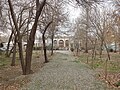 Northern facade from the garden, 2024
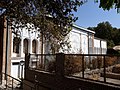 Southern facade, 2018
 Southern entrance, 2018
 Entrance, 2020
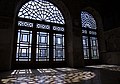 Interior, 2018


