Spark (mathematics)
From Wikipedia, the free encyclopedia
In mathematics, more specifically in linear algebra, the spark of a matrix is the smallest integer such that there exists a set of columns in which are linearly dependent. If all the columns are linearly independent, is usually defined to be 1 more than the number of rows. The concept of matrix spark finds applications in error-correction codes, compressive sensing, and matroid theory, and provides a simple criterion for maximal sparsity of solutions to a system of linear equations.


The spark of a matrix is NP-hard to compute.
Formally, the spark of a matrix is defined as follows:
| Eq.1 |

where is a nonzero vector and denotes its number of nonzero coefficients[1] ( is also referred to as the size of the support of a vector). Equivalently, the spark of a matrix is the size of its smallest circuit (a subset of column indices such that has a nonzero solution, but every subset of it does not[1]).


If all the columns are linearly independent, is usually defined to be (if has m rows).[2][3][dubious – discuss]

By contrast, the rank of a matrix is the largest number such that some set of columns of is linearly independent.[4]
Example
Consider the following matrix .
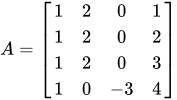
The spark of this matrix equals 3 because:
- There is no set of 1 column of which are linearly dependent.
- There is no set of 2 columns of which are linearly dependent.
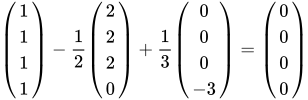
- But there is a set of 3 columns of which are linearly dependent. The first three columns are linearly dependent because .
Properties
If , the following simple properties hold for the spark of a matrix :

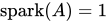
- (If the spark equals , then the matrix has full rank.)
- if and only if the matrix has a zero column.
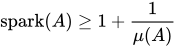
- .[4]


Criterion for uniqueness of sparse solutions
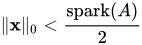
The spark yields a simple criterion for uniqueness of sparse solutions of linear equation systems.[5] Given a linear equation system . If this system has a solution that satisfies , then this solution is the sparsest possible solution. Here denotes the number of nonzero entries of the vector .