Spectral concentration problem
From Wikipedia, the free encyclopedia

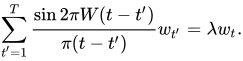
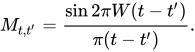
The spectral concentration problem in Fourier analysis refers to finding a time sequence of a given length whose discrete Fourier transform is maximally localized on a given frequency interval, as measured by the spectral concentration.
The discrete Fourier transform (DFT) U(f) of a finite series , is defined as


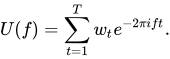
In the following, the sampling interval will be taken as Δt = 1, and hence the frequency interval as f ∈ [-1/2,1/2]. U(f) is a periodic function with a period 1.
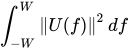
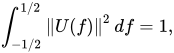
For a given frequency W such that 0<W<1/2, the spectral concentration of U(f) on the interval [-W,W] is defined as the ratio of power of U(f) contained in the frequency band [-W,W] to the power of U(f) contained in the entire frequency band [-1/2,1/2]. That is,

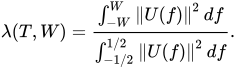
It can be shown that U(f) has only isolated zeros and hence (see [1]). Thus, the spectral concentration is strictly less than one, and there is no finite sequence for which the DTFT can be confined to a band [-W,W] and made to vanish outside this band.