One popular metric,[1] used in the study of mass inflation, is

Here,  is the standard metric on the unit radius 2-sphere
  . The radial coordinate
  is defined so that it is the circumferential radius, that is, so that the proper circumference at radius
is
is defined so that it is the circumferential radius, that is, so that the proper circumference at radius
is  . In this coordinate choice, the parameter
  is defined so that
  is the proper rate of change of the circumferential radius (that is, where
  is the proper time). The parameter
  can be interpreted as the radial derivative of the circumferential radius in a freely-falling frame; this becomes explicit in the tetrad formalism.
Note that the above metric is written as a sum of squares, and therefore it can be understood as explicitly encoding a vierbein, and, in particular, an orthonormal tetrad. That is, the metric tensor can be written as a pullback of the Minkowski metric  :
:
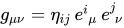
where the  is the inverse vierbein. The convention here and in what follows is that the roman indexes refer to the flat orthonormal tetrad frame, while the greek indexes refer to the coordinate frame. The inverse vierbein can be directly read off of the above metric as
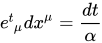
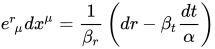
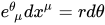

where the signature was take to be  . Written as a matrix, the inverse vierbein is
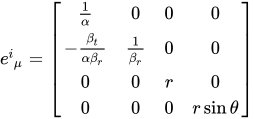
The vierbein itself is the inverse(-transpose) of the inverse vierbein
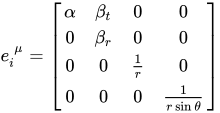
That is,  is the identity matrix.
The particularly simple form of the above is a prime motivating factor for working with the given metric.
The vierbein relates vector fields in the coordinate frame to vector fields in the tetrad frame, as
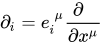
The most interesting of these two are  which is the proper time in the rest frame, and
  which is the radial derivative in the rest frame. By construction, as noted earlier, was the proper
rate of change of the circumferential radius; this can now be explicitly written as
which is the radial derivative in the rest frame. By construction, as noted earlier, was the proper
rate of change of the circumferential radius; this can now be explicitly written as

Similarly, one has

which describes the gradient (in the free-falling tetrad frame) of the circumferential radius along the radial direction. This is not in general unity; compare, for example, to the standard Swarschild solution, or the Reissner–Nordström solution. The sign of effectively determines "which way is down"; the sign of distinguishes incoming and outgoing frames, so that  is an ingoing frame, and
  is an outgoing frame.
These two relations on the circumferential radius provide another reason why this particular parameterization of the metric is convenient: it has a simple intuitive characterization.
The connection form in the tetrad frame can be written in terms of the Christoffel symbols  in the tetrad frame, which are given by


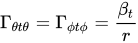
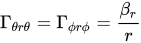
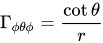
and all others zero.
A complete set of expressions for the Riemann tensor, the Einstein tensor and the Weyl curvature scalar can be found in Hamilton & Avelino.[1] The Einstein equations become
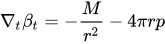

where  is the covariant time derivative (and
  the Levi-Civita connection),
  the radial pressure (not the isotropic pressure!), and
  the radial energy flux. The mass
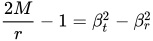
  is the Misner-Thorne mass or interior mass, given by
As these equations are effectively two-dimensional, they can be solved without overwhelming difficulty for a variety of assumptions about the nature of the infalling material (that is, for the assumption of a spherically symmetric black hole that is accreting charged or neutral dust, gas, plasma or dark matter, of high or low temperature, i.e. material with various equations of state.)




