Spinh structure
Special tangential structure
From Wikipedia, the free encyclopedia
In spin geometry, a spinh structure (or quaternionic spin structure) is a generalization of a spin structure. In mathematics, these are used to describe spinor bundles and spinors, which in physics are used to describe spin, an intrinsic angular momentum of particles after which they have been named. Since spinh structures also exist under weakened conditions, which might not allow spin structures, they provide a suitable alternative for such situations. Orientable manifolds with spinh structures are called spinh manifolds.[1] H stands for the quaternions, which are denoted and appear in the definition of the underlying spinh group.

Definition
Let be a -dimensional orientable manifold. Its tangent bundle is described by a classifying map into the classifying space of the special orthogonal group . It can factor over the map induced by the canonical projection on classifying spaces. In this case, the classifying map lifts to a continuous map into the classifying space of the spinh group . Its homotopy class is called spinh structure.[2]


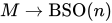


Assume has a spinh structure. Let then denote the set of spinh structures on . The first symplectic group is the second factor of the spinh group and using its classifying space , which is the infinite quaternionic projective space and through its Postnikov tower projects onto the Eilenberg–MacLane space , there is a map:[citation needed]


![{\displaystyle \operatorname {Spin} ^{\mathrm {h} }(M)\cong [M,\operatorname {BSp} (1)]\cong [M,\mathbb {H} P^{\infty }]\rightarrow [M,K(\mathbb {Z} ,4)]\cong H^{4}(M,\mathbb {Z} ).}](http://wikimedia.org/api/rest_v1/media/math/render/svg/e9a76a047090bb05c91e8928e62bd8969ffe0f6b)
The former isomorphism follows from the Puppe sequence for the fibration (when applying ).[3] Although this map is not a bijection in general, it is in special cases, for example for a 4-manifold .

![{\displaystyle [M,-]}](http://wikimedia.org/api/rest_v1/media/math/render/svg/aa5962268f82ce05f794ae9a92e49fc61597a65e)
Due to the canonical projection , every spinh structure induces a principal -bundle or equivalently a orientable real vector bundle of third rank.[citation needed]


Properties
- Every spin and even every spinc structure induces a spinh structure. Reverse implications don't hold as the complex projective plane and the Wu manifold show.[4]
- If an orientable manifold has a spinh structure, then its fifth integral Stiefel–Whitney class vanishes, hence is the image of the fourth ordinary Stiefel–Whitney class under the canonical map .
- Every compact orientable smooth manifold with seven or less dimensions has a spinh structure.[5]
- In eight dimensions, there are infinitely many homotopy types of closed simply connected manifolds without spinh structure.[6]
- For a compact spinh manifold of even dimension with either vanishing fourth Betti number or the first Pontrjagin class of its canonical principal -bundle being torsion, twice its  genus is integer.[7]


The following properties hold more generally for the lift on the Lie group , with the particular case giving:


- If is a spinh manifold, then and are spinh manifolds.[8]
- If is a spin manifold, then is a spinh manifold iff is a spinh manifold.[8]
- If and are spinh manifolds of same dimension, then their connected sum is a spinh manifold.[9]
- The following conditions are equivalent:[10]
- is a spinh manifold.
- There is a real vector bundle of third rank, so that has a spin structure or equivalently .
- can be immersed in a spin manifold with three dimensions more.
- can be embedded in a spin manifold with three dimensions more.


Cohomology of infinite classifying space
The cohomology ring of the infinite classifying space with coefficients in can be expressed using Steenrod squares and Wu classes:[11][12]


See also
Literature
- Christian Bär (1999). "Elliptic symbols". Mathematische Nachrichten. 201 (1).
- Michael Albanese und Aleksandar Milivojević (2021). "Spinh and further generalisations of spin". Journal of Geometry and Physics. 164: 104–174. arXiv:2008.04934. doi:10.1016/j.geomphys.2022.104709.
- H. Blaine Lawson (2023-01-23). "Spinʰ Manifolds". arXiv:2301.09683v1 [math.DG].
- Jiahao Hu (2023-12-08). "Invariants of Real Vector Bundles". arXiv:2310.05061 [math.AT].