Spirobolida
Order of millipedes
From Wikipedia, the free encyclopedia
Spirobolida is an order of "round-backed" millipedes containing approximately 500 species in 12 families.[1] Its members are distinguished by the presence of a "pronounced suture that runs "vertically down the front of the head".[2] Most of the species live in the tropics, and many are brightly coloured.[2] Mature males have two pairs of modified legs, the gonopods, consisting of the eighth and ninth leg pairs: the posterior gonopods are used in sperm-transfer while the anterior gonopods are fused into a single plate-like structure.[3]

| Spirobolida | |
|---|---|
 | |
| Narceus americanus (Spirobolidae) | |
Scientific classification  | |
| Kingdom: | Animalia |
| Phylum: | Arthropoda |
| Subphylum: | Myriapoda |
| Class: | Diplopoda |
| Superorder: | Juliformia |
| Order: | Spirobolida Bollman, 1893 |
| Families | |
|
12: See text | |
| Synonyms | |
| |
The families are divided into two suborders:[1]
Suborder Spirobolidea
- Allopocockiidae
- Atopetholidae
- Floridobolidae
- Hoffmanobolidae
- Messicobolidae
- Pseudospirobolellidae
- Rhinocricidae
- Spirobolellidae
- Spirobolidae
- Typhlobolellidae
Suborder Trigoniulidea
Select species
- Narceus americanus, a commonly seen species in eastern North America
- Crurifarcimen vagans, the "wandering leg sausage"
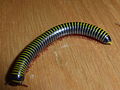
- Anadenobolus monilicornis, the yellow-banded millipede
- Eucarlia, a genus of threatened Indo-Pacific millipedes
Gallery
 Comanchelus chihuanus (Atopetholidae)
 Spirobolellus immigrans (Spirobolellidae) in ethanol


_(10518110246).jpg)