Split and merge segmentation
From Wikipedia, the free encyclopedia
Split and merge segmentation is an image processing technique used to segment an image. The image is successively split into quadrants based on a homogeneity criterion and similar regions are merged to create the segmented result. The technique incorporates a quadtree data structure, meaning that there is a parent-child node relationship. The total region is a parent, and each of the four splits is a child.
- Define the criterion to be used for homogeneity
- Split the image into equal size regions
- Calculate homogeneity for each region
- If the region is homogeneous, then merge it with neighbors
- The process is repeated until all regions pass the homogeneity test[1]
Homogeneity
After each split, a test is necessary to determine whether each new region needs further splitting. The criterion for the test is the homogeneity of the region. There are several ways to define homogeneity, some examples are:
- Uniformity- the region is homogeneous if its gray scale levels are constant or within a given threshold.
- Local mean vs global mean - if the mean of a region is greater than the mean of the global image, then the region is homogeneous
- Variance - the gray level variance is defined as
![{\displaystyle \sigma ^{2}=(1/(N-1))\sum _{(r,c)\epsilon R}[I(r,c)-{\bar {I}}]^{2}}](https://wikimedia.org/api/rest_v1/media/math/render/svg/f631a38d762892cb063131191ee7af4e874032e3)
where r and c are row and column, N is the number of pixels in the region and
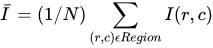
An example incorporation would be that the variance of a region be less than a specified value in order to be considered homogeneous.


