Spyridium obcordatum
From Wikipedia, the free encyclopedia
| Spyridium obcordatum | |
|---|---|
 | |
| In the Australian National Botanic Gardens | |
Scientific classification  | |
| Kingdom: | Plantae |
| Clade: | Tracheophytes |
| Clade: | Angiosperms |
| Clade: | Eudicots |
| Clade: | Rosids |
| Order: | Rosales |
| Family: | Rhamnaceae |
| Genus: | Spyridium |
| Species: | S. obcordatum |
| Binomial name | |
| Spyridium obcordatum | |
| Synonyms[1] | |
| |
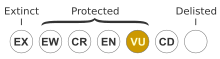
Spyridium obcordatum, commonly known as creeping spyridium[2] or creeping dustymiller,[3] is a species of flowering plant in the family Rhamnaceae and is endemic to Tasmania. It is a prostrate shrub with heart-shaped leaves, the narrower end towards the base, and clusters of hairy, white flowers.
Spyridium obcordatum is a prostrate shrub that has many twiggy, wiry branches up to 40 cm (16 in) long. The leaves are egg-shaped to heart-shaped with the narrower end towards the base, mostly 4–10 mm (0.16–0.39 in) long with the edges curved downwards. The upper surface of the leaves is more or less glabrous and the lower surface is covered with greyish or white hairs. Heads of flowers are arranged on the ends of branchlets, surrounded by brown bracts and petal-like leaves, the individual flowers white and about 3 mm (0.12 in) wide. Flowering occurs from mid-September to October.[2][3][4]
Taxonomy
This species was first formally described in 1855 by Joseph Dalton Hooker who gave it the name Cryptandra obcordata in The botany of the Antarctic voyage of H.M. Discovery ships Erebus and Terror from specimens collected by Ronald Campbell Gunn.[5][6] In 1970, Winifred Curtis changed the name to Spyridium obcordatum in The Victorian Naturalist.[7] The specific epithet (obcordatum) means "heart-shaped, attached at the pointed end".[8]
