Stability radius
From Wikipedia, the free encyclopedia
In mathematics, the stability radius of an object (system, function, matrix, parameter) at a given nominal point is the radius of the largest ball, centered at the nominal point, all of whose elements satisfy pre-determined stability conditions. The picture of this intuitive notion is this:

where denotes the nominal point, denotes the space of all possible values of the object , and the shaded area, , represents the set of points that satisfy the stability conditions. The radius of the blue circle, shown in red, is the stability radius.





History
Relation to Wald's maximin model
It was shown[2] that the stability radius model is an instance of Wald's maximin model. That is,

where
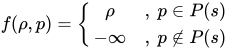
The large penalty () is a device to force the player not to perturb the nominal value beyond the stability radius of the system. It is an indication that the stability model is a model of local stability/robustness, rather than a global one.


Info-gap decision theory
Info-gap decision theory is a recent non-probabilistic decision theory. It is claimed to be radically different from all current theories of decision under uncertainty. But it has been shown[2] that its robustness model, namely

is actually a stability radius model characterized by a simple stability requirement of the form where denotes the decision under consideration, denotes the parameter of interest, denotes the estimate of the true value of and denotes a ball of radius centered at .


Since stability radius models are designed to deal with small perturbations in the nominal value of a parameter, info-gap's robustness model measures the local robustness of decisions in the neighborhood of the estimate .
Sniedovich[2] argues that for this reason the theory is unsuitable for the treatment of severe uncertainty characterized by a poor estimate and a vast uncertainty space.
Alternate definition
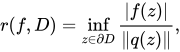
There are cases where it is more convenient to define the stability radius slightly different. For example, in many applications in control theory the radius of stability is defined as the size of the smallest destabilizing perturbation in the nominal value of the parameter of interest.[7] The picture is this:

More formally,

where denotes the distance of from .