Stanislaŭ Šabunieŭski
From Wikipedia, the free encyclopedia
Stanislaŭ Šabunieŭski | |
|---|---|
Станіслаў Шабунеўскі | |
 | |
| Born | 1868 Skarodnaje, Yelʹsk District, Russian Empire |
| Died | 1937 (aged 68–69) |
| Occupation | Architect |
Stanislaŭ Šabunieŭski (Belarusian: Станіслаў Шабунеўскі, 1868–1937) was an architect whose buildings "in many respects determined the modern appearance of Gomel"[1] and a victim of Stalin's purges.
Šabunieŭski was born into an impoverished Belarusian noble family in the village of Skarodnaje (now in the Yelʹsk District of Belarus). His father served as a postman, later as an assistant postmaster at the Babruysk district post office.[1][2]
Šabunieŭski graduated from a gymnasium in Slutsk, then studied architecture in St. Petersburg. In 1897, he came to Gomel and started working in the local construction department of the Libau–Romny Railway.[1][2]
Architectural career
In the early 20th century, Šabunieŭski became a prolific designer of buildings in the centre of Gomel, alternating between different architectural styles – from classicism to modernism to constructivism. His first building designed in 1898 was a men's classical gymnasium, which combined the motifs of classical architecture and the then modern engineering techniques. Today, the building houses the Belarusian State University of Transport.[1][3][4]
He went on to design the offices of the Aroł and Vilna commercial banks, Savoy hotel (destroyed during military hostilities in 1919), fire station as well as grand houses for Gomel merchants and prosperous professionals. In 1913, Šabunieŭski designed a district hospital funded by the last owner of the Gomel Palace, Princess Iryna Paskievič. Today the building still functions as a hospital.[1][2][4]
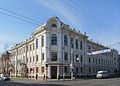 Building of the former Aroł commercial bank
 Building of the former Vilna commercial bank
 Building of the former district hospital


