Stele of Ushumgal
From Wikipedia, the free encyclopedia
31°37′17″N 45°56′00″E / 31.621369°N 45.933406°E
| Stele of Ushumgal | |
|---|---|
 | |
| Material | Gypsum alabaster |
| Height | 22 cm |
| Created | c. 2800 BC |
| Discovered | Possibly Umma 31°37′17″N 45°56′00″E / 31.621369°N 45.933406°E |
| Present location | Metropolitan Museum of Art, New York City |
| Registration | Metropolitan Museum of Art 58.29 |


The Stele of Ushumgal is an early Sumerian stone tablet, dating to the Early Dynastic I-II (c. 2900-2700 BCE), and probably originating from Umma.[3][4] It is currently located in the Metropolitan Museum of Art, New York City.[3][1][5]
The stele is 22 cm high. It is partially deciphered, refers to an early transfer of land ownership. A large man is inscribed with a label, which can be read “Ušumgal, the pab-šeš priest of (the deity) Šara”. On the other side stands Shara-igizi-Abzu, the daughter of Ushumgal.[3][1][6]
The stele has been described as a type of "ancient Kudurru", a sort of stele known from the Kassites period in the 2nd millennium BCE.[7][8]
The name "Akka" appears in the Stele of Ushumgal, as Ak gal-ukkin, "Ak gal-ukkin official". It has been suggested this could refer to Aga of Kish himself.[9][10]
 The daughter of Ushumgal
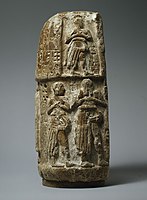 Three men, possibly from a local council
 The name "Akka" appears in the Stele of Ushumgal, as Ak gal-ukkin, "Ak gal-ukkin official". It has been suggested this could refer to King Aga of Kish himself.[9][11]
 Another figure
 Line art of Aga of Kish from the Stele of Ushumgal


