Stenocereus humilis
From Wikipedia, the free encyclopedia
| Stenocereus humilis | |
|---|---|
Scientific classification  | |
| Kingdom: | Plantae |
| Clade: | Tracheophytes |
| Clade: | Angiosperms |
| Clade: | Eudicots |
| Order: | Caryophyllales |
| Family: | Cactaceae |
| Subfamily: | Cactoideae |
| Genus: | Stenocereus |
| Species: | S. humilis |
| Binomial name | |
| Stenocereus humilis (Britton & Rose) D.R.Hunt 2002 | |
| Synonyms | |
| |
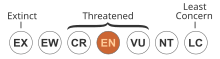
Stenocereus humilis is a species of cactus in the genus Stenocereus, endemic to Mexico.
Stenocereus humilis is a shrub characterized by irregularly branched shoots, often forming dense thickets. The shoots are weak and dark green, measuring between 1 and 4 meters in length and reaching a diameter of up to 4 centimeters. They have three to six interrupted ribs, with woolly areoles located in their notches. The plant features five to eight needle-like spines that start off brown and later turn whitish, measuring 1 to 2 centimeters in length.
The flowers of Stenocereus humilis are funnel-shaped, greenish-white, and can grow up to 6 centimeters in length. The spherical fruits are heavily spined and can reach up to 4 centimeters in length.[2]
Distribution
This species is commonly found in the Cauca department of Colombia, particularly in the valley of the Río Dagua at altitudes between 700 and 1,000 meters.
