Stenocereus standleyi
From Wikipedia, the free encyclopedia
| Stenocereus standleyi | |
|---|---|
 | |
Scientific classification  | |
| Kingdom: | Plantae |
| Clade: | Tracheophytes |
| Clade: | Angiosperms |
| Clade: | Eudicots |
| Order: | Caryophyllales |
| Family: | Cactaceae |
| Subfamily: | Cactoideae |
| Genus: | Stenocereus |
| Species: | S. standleyi |
| Binomial name | |
| Stenocereus standleyi (J.G.Ortega) Buxb. 1961 | |
| Synonyms | |
| |
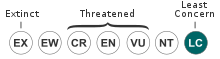
Stenocereus standleyi is a species of cactus in the genus Stenocereus, endemic to Mexico.
Stenocereus standleyi typically grows in a spreading or slightly tree-like form, featuring numerous branching shoots and reaching heights of 2 to 4 meters without a distinct trunk. The light green shoots can be up to 8 centimeters in diameter and usually have four broad, notched ribs. They possess four to six central spines, which start off reddish and become gray as they age, measuring 2 to 2.5 centimeters long. Additionally, there are 10 to 16 radial spines, each 10 to 15 millimeters long, which also turn gray over time. The plant produces narrow, bell-shaped white flowers that bloom at night and measure 6 to 8 centimeters in length. Its egg-shaped reddish fruits, which reach a diameter of 3 to 4 centimeters with red or orange pulp and black seeds. Fruits are covered in curved areoles.[2]
Distribution
Stenocereus standleyi is commonly found in several Mexican states, including Colima, Guerrero, Jalisco, Michoacán, Nayarit, and Sinaloa.

