Stichodactyla gigantea
Species of sea anemone
From Wikipedia, the free encyclopedia
Stichodactyla gigantea, commonly known as the giant carpet anemone,[2] is a species of sea anemone that lives in the Hawaii, USA, North America, and Indo-Pacific area. It can be kept in an aquarium but is a very challenging species to keep alive and healthy for more than 3–5 years.

| Stichodactyla gigantea | |
|---|---|
| |
| Stichodactlya gigantea with false percula clownfish, Amphiprion ocellaris | |
Scientific classification  | |
| Kingdom: | Animalia |
| Phylum: | Cnidaria |
| Subphylum: | Anthozoa |
| Class: | Hexacorallia |
| Order: | Actiniaria |
| Family: | Stichodactylidae |
| Genus: | Stichodactyla |
| Species: | S. gigantea |
| Binomial name | |
| Stichodactyla gigantea | |
| Synonyms | |
|
List
| |
Description
Stichodactyla gigantea has a diameter that is usually no larger than 50 centimetres (1.6 ft) and a maximum of 80 centimetres (2.6 ft).[3] It can appear in a number of colors, commonly brown or greenish and rarely a striking purple or pink, deep blue, or bright green.[4] A healthy S. gigantea will possess tentacles that are extremely sticky to the touch, with firm adherence to surfaces.[4]
 Blue
Blue Beige
Beige Green
Green Orange
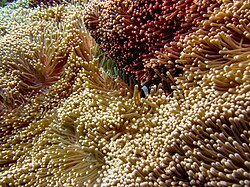 Tan
Tan


Ecology
S. gigantea resides on shallow seagrass beds or sand flats around 8 centimetres (3.1 in) deep (at low tide).[5] Most anemones are treated as sessile, but the ones inhabited by anemonefish are in fact motile.[4] Zooxanthellae are obligate symbionts within the anemone.
S. gigantea hosts 7 different species of anemonefish
- Amphiprion akindynos (Barrier reef anemonefish)
- A. bicinctus (Two-band anemonefish)
- A. clarkii (Clark's anemonefish)
- A. ocellaris (False clownfish)
- A. percula (Clownfish)
- A. perideraion (Pink skunk anemonefish)
- A. rubrocinctus (Australian anemonefish)
Juvenile Dascyllus trimaculatus also associate with S. gigantea.[4]
Aquarium trade
S. gigantea is uncommon in the aquarium trade.[6] Though smaller in size than other carpet anemone species, it is significantly more delicate, and requires a large, mature reef aquarium. Like all sea anemones in captivity that have a symbiotic, mutualistic relationship with anemonefish, S. gigantea requires intense aquarium lighting, impeccable water quality, and stable parameters.[6] It is prone to shipping stress and bacterial infections during transit.[6] Due to these factors, many hobbyists advocate quarantining this anemone and treating with antibiotics such as Ciprofloxacin or Septra for a minimum of one week before acclimating it to the main tank.[7]

