Stream power is the rate of potential energy loss per unit of channel length.[7] This potential energy is lost moving particles along the stream bed.

where  is the stream power,
  is the density of water,
  is the gravitational acceleration,
  is the channel slope, and
  is the discharge of the stream.
The discharge of a stream, , is the velocity of the stream,  , multiplied by the cross-sectional area,
  , of the stream channel at that point:

in which is the discharge of the stream, is the average stream velocity, and is the cross-sectional area of the stream.
As velocity increases, so does stream power, and a larger stream power corresponds to an increased ability to move bed load particles.
In order for sediment transport to occur in gravel bed channels, flow strength must exceed a critical threshold, called the critical threshold of entrainment, or threshold of mobility. Flow over the surface of a channel and floodplain creates a boundary shear stress field. As discharge increases, shear stress increases above a threshold and starts the process of sediment transport. A comparison of the flow strength available during a given discharge to the critical shear strength needed to mobilize the sediment on the bed of the channel helps us predict whether or not sediment transport is likely to occur, and to some degree, the sediment size likely to move. Although sediment transport in natural rivers varies wildly, relatively simple approximations based on simple flume experiments are commonly used to predict transport.[8] Another way to estimate stream competency is to use the following equation for critical shear stress,  which is the amount of shear stress required to move a particle of a certain diameter.[9]

where:
 Shields parameter, a dimensionless value which describes the resistance of the stream bed to gravitational acceleration, also described as roughness or friction,
 Particle density, and
  is the effective density of the particle when submerged in water (Archimedes principle).[10]
 Gravitational acceleration.
 grain diameter, usually measured as d50 which is the median particle diameter when sampling particle diameters in a stream transect.
The shear stress of a stream is represented by the following equation:

where:
 average depth
 stream slope.
If we combine the two equations we get:

Solving for particle diameter d we get
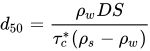
The equation shows particle diameter,  , is directly proportional to both the depth of water and slope of stream bed (flow and velocity), and inversely proportional to Shield's parameter and the effective density of the particle.
Velocity differences between the bottom and tops of particles can lead to lift. Water is allowed to flow above the particle but not below resulting in a zero and non-zero velocity at the bottom and top of the particle respectively. The difference in velocities results in a pressure gradient that imparts a lifting force on the particle. If this force is greater than the particle's weight, it will begin transport.[11]
Flows are characterized as either laminar or turbulent. Low-velocity and high-viscosity fluids are associated with laminar flow, while high-velocity and low-viscosity are associated with turbulent flows. Turbulent flows result velocities that vary in both magnitude and direction. These erratic flows help keep particles suspended for longer periods of time. Most natural channels are considered to have turbulent flow.[7]


