String topology
From Wikipedia, the free encyclopedia
String topology, a branch of mathematics, is the study of algebraic structures on the homology of free loop spaces. The field was started by Moira Chas and Dennis Sullivan (1999).
While the singular cohomology of a space has always a product structure, this is not true for the singular homology of a space. Nevertheless, it is possible to construct such a structure for an oriented manifold of dimension . This is the so-called intersection product. Intuitively, one can describe it as follows: given classes and , take their product and make it transversal to the diagonal . The intersection is then a class in , the intersection product of and . One way to make this construction rigorous is to use stratifolds.






Another case, where the homology of a space has a product, is the (based) loop space of a space . Here the space itself has a product



by going first through the first loop and then through the second one. There is no analogous product structure for the free loop space of all maps from to since the two loops need not have a common point. A substitute for the map is the map



where is the subspace of , where the value of the two loops coincides at 0 and is defined again by composing the loops.



The Chas–Sullivan product
The idea of the Chas–Sullivan product is to now combine the product structures above. Consider two classes and . Their product lies in . We need a map
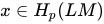
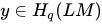



One way to construct this is to use stratifolds (or another geometric definition of homology) to do transversal intersection (after interpreting as an inclusion of Hilbert manifolds). Another approach starts with the collapse map from to the Thom space of the normal bundle of . Composing the induced map in homology with the Thom isomorphism, we get the map we want.

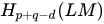
Now we can compose with the induced map of to get a class in , the Chas–Sullivan product of and (see e.g. Cohen & Jones (2002)).

Remarks
- As in the case of the intersection product, there are different sign conventions concerning the Chas–Sullivan product. In some convention, it is graded commutative, in some it is not.
- The same construction works if we replace by another multiplicative homology theory if is oriented with respect to .
- Furthermore, we can replace by . By an easy variation of the above construction, we get that is a module over if is a manifold of dimensions .
- The Serre spectral sequence is compatible with the above algebraic structures for both the fiber bundle with fiber and the fiber bundle for a fiber bundle , which is important for computations (see Cohen, Jones & Yan (2004) and Meier (2010)).











![{\displaystyle [S^{1}]\in H_{1}(S^{1})}](https://wikimedia.org/api/rest_v1/media/math/render/svg/374a4f778fe7286f95c14f452e1b4d7f6f54718f)


.svg)


