Subordinator (mathematics)
From Wikipedia, the free encyclopedia
In probability theory, a subordinator is a stochastic process that is non-negative and whose increments are stationary and independent.[1] Subordinators are a special class of Lévy process that play an important role in the theory of local time.[2] In this context, subordinators describe the evolution of time within another stochastic process, the subordinated stochastic process. In other words, a subordinator will determine the random number of "time steps" that occur within the subordinated process for a given unit of chronological time.
In order to be a subordinator a process must be a Lévy process[3]. It also must be increasing, almost surely,[3] or an additive process.[4]
A subordinator is a real-valued stochastic process that is a non-negative and a Lévy process.[1] Subordinators are the stochastic processes that have all of the following properties:
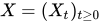
- almost surely
- is non-negative, meaning for all
- has stationary increments, meaning that for and , the distribution of the random variable depends only on and not on
- has independent increments, meaning that for all and all , the random variables defined by are independent of each other
- The paths of are càdlàg, meaning they are continuous from the right everywhere and the limits from the left exist everywhere