Summation theorems (biochemistry)
From Wikipedia, the free encyclopedia
In metabolic control analysis, a variety of theorems have been discovered and discussed in the literature.[1][2][3][4] The most well known of these are flux and concentration control coefficient summation relationships. These theorems are the result of the stoichiometric structure and mass conservation properties of biochemical networks.[5][6] Equivalent theorems have not been found, for example, in electrical or economic systems.
The summation of the flux and concentration control coefficients were discovered independently by the Kacser/Burns group[7] and the Heinrich/Rapoport group[8] in the early 1970s and late 1960s.
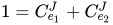
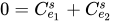
If we define the control coefficients using enzyme concentration, then the summation theorems are written as:


However these theorems depend on the assumption that reaction rates are proportional to enzyme concentration. An alternative way to write the theorems is to use control coefficients that are defined with respect to the local rates which is therefore independent of how rates respond to changes in enzyme concentration:


Although originally derived for simple linear chains of enzyme catalyzed reactions, it became apparent that the theorems applied to pathways of any structure including pathways with complex regulation involving feedback control.[9][10]
There are different ways to derive the summation theorems. One is analytical and rigorous using a combination of linear algebra and calculus.[11] The other is less rigorous, but more operational and intuitive. The latter derivation is shown here.
Consider the two-step pathway:
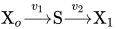
where and are fixed species so that the system can achieve a steady-state.


Let the pathway be at steady-state and imagine increasing the concentration of enzyme, , catalyzing the first step, , by an amount, . The effect of this is to increase the steady-state levels of S and flux, J. Let us now increase the level of by such that the change in S is restored to the original value it had at steady-state.


The net effect of these two changes is by definition, .

There are two ways to look at this thought experiment, from the perspective of the system and from the perspective of local changes. For the system we can compute the overall change in flux or species concentration by adding the two control coefficient terms, thus:
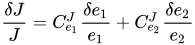

We can also look at what is happening locally at every reaction step for which there will be two: one for , and another for . Since the thought experiment guarantees that , the local equations are quite simple:

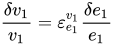
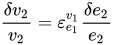
where the terms are the elasticities. However, because the enzyme elasticity is equal to one, these reduce to:


Because the pathway is linear, at steady-state, . We can substitute these expressions into the system equations to give:

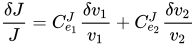

Note that at steady state the change in and must be the same, therefore .

Setting , we can rewrite the above equations as:



We then conclude through cancelation of since , that: