Supertrace
From Wikipedia, the free encyclopedia
In the theory of superalgebras, if A is a commutative superalgebra, V is a free right A-supermodule and T is an endomorphism from V to itself, then the supertrace of T, str(T) is defined by the following trace diagram:

More concretely, if we write out T in block matrix form after the decomposition into even and odd subspaces as follows,
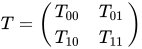
then the supertrace
- str(T) = the ordinary trace of T00 − the ordinary trace of T11.
Let us show that the supertrace does not depend on a basis. Suppose e1, ..., ep are the even basis vectors and ep+1, ..., ep+q are the odd basis vectors. Then, the components of T, which are elements of A, are defined as
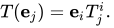
The grading of Tij is the sum of the gradings of T, ei, ej mod 2.
A change of basis to e1', ..., ep', e(p+1)', ..., e(p+q)' is given by the supermatrix

and the inverse supermatrix
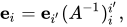
where of course, AA−1 = A−1A = 1 (the identity).
We can now check explicitly that the supertrace is basis independent. In the case where T is even, we have

In the case where T is odd, we have

The supertrace satisfies the property

for all T1, T2 in End(V). In particular, the supertrace of a supercommutator is zero.
In fact, one can define a supertrace more generally for any associative superalgebra E over a commutative superalgebra A as a linear map tr: E -> A which vanishes on supercommutators.[1] Such a supertrace is not uniquely defined; it can always at least be modified by multiplication by an element of A.
![{\displaystyle \operatorname {str} [M^{2}]=\sum _{s}(-1)^{2s}(2s+1)\operatorname {tr} [m_{s}^{2}].}](https://wikimedia.org/api/rest_v1/media/math/render/svg/74f86504846549ad376788c0a5c951282bef8f99)

![{\displaystyle V_{eff}^{1-loop}={\dfrac {1}{64\pi ^{2}}}\operatorname {str} {\bigg [}M^{4}\ln {\Big (}{\dfrac {M^{2}}{\Lambda ^{2}}}{\Big )}{\bigg ]}={\dfrac {1}{64\pi ^{2}}}\operatorname {tr} {\bigg [}m_{B}^{4}\ln {\Big (}{\dfrac {m_{B}^{2}}{\Lambda ^{2}}}{\Big )}-m_{F}^{4}\ln {\Big (}{\dfrac {m_{F}^{2}}{\Lambda ^{2}}}{\Big )}{\bigg ]}}](https://wikimedia.org/api/rest_v1/media/math/render/svg/8ceca6eb7dd88d87a211dd920f3be96f46d61f15)


