Source:[2]
Let the object be in contact at a finite number of points  . At each point
  , let
, let  be the set of forces that can be applied on the object at that point. Here, is known as the friction cone, and for the Coulomb model of friction, is actually a cone with apex at the origin, extending to infinity in the normal direction of the contact.
Let  be the (unspecified) forces at the contact points. To balance the object in static equilibrium, the following Newton-Euler equations must be met on :
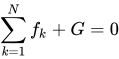
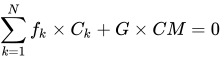
 for all
where  is the force of gravity on the object, and
  is its center of mass. The first two equations are the Newton-Euler equations, and the third requires all forces to be valid. If there is no set of forces that meet all these conditions, the object will not be in equilibrium.
The second equation has no dependence on the vertical component of the center of mass, and thus if a solution exists for one , the same solution works for all  . Therefore, the set of all that have solutions to the above conditions is a set that extends infinitely in the up and down directions. The support polygon is simply the projection of this set on the horizontal plane.
These results can easily be extended to different friction models and an infinite number of contact points (i.e. a region of contact).
