System of National Banks (Yugoslavia)
From Wikipedia, the free encyclopedia
.jpg)
The System of National Banks (Serbo-Croatian: sustav narodnih banaka) was a decentralized framework for monetary and financial policies of Yugoslavia from the early 1970s to 1993, involving the National Bank of Yugoslavia (NBJ) together with the eight central banks of the respective six constituent republics and two autonomous provinces of the Socialist Federal Republic of Yugoslavia. Each of the nine participant banks had a degree of policy autonomy, making the system more decentralized than the later Eurosystem, with which the System of National Banks shared some features.
The System of National Banks was prone to hyperinflation and eventually collapsed in 1990. With the breakup of Yugoslavia in 1991-1992, four of the National Banks became fully independent central banks of their respective newly independent countries, namely Bosnia and Herzegovina, Croatia, Macedonia, and Slovenia. The five remaining entities of the System, including the National Bank of Yugoslavia were consolidated in 1993 into a unitary entity of the same name in the Federal Republic of Yugoslavia.
The System of National Banks was established as part of the decentralizing policies pioneered by Josip Broz Tito starting in the 1960s. The National Bank of Bosnia and Herzegovina, National Bank of Croatia, National Bank of Macedonia, National Bank of Montenegro, National Bank of Serbia, and National Bank of Slovenia were all established in 1971 and organized by subsequent legislation; the National Bank of Kosovo and National Bank of Vojvodina were established a year later, in 1972.[1]: 4 The individual National Banks were accountable solely to the parliaments of the respective Republics and Autonomous Provinces.[2]: 57
Their respective Governors were ex officio members of the Board of Governors of the National Bank of Yugoslavia.[3]: 104 Until 1986, decisions of the Board were made by consensus; in late 1986, that rule was replace by two-thirds majority decision-making.[2]: 63
 Former seat of the National Bank of Bosnia and Herzegovina, Sarajevo, lately Central Bank of Bosnia and Herzegovina
 Former seat of the National Bank of Croatia, Zagreb, lately Croatian National Bank
 Former seat of the National Bank of Macedonia, Skopje, lately National Bank of North Macedonia
 Former seat of the National Bank of Montenegro, Podgorica, lately Central Bank of Montenegro
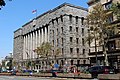 Former seat of the National Bank of Serbia, Belgrade, lately Constitutional Court of Serbia
 Former seat of the National Bank of Slovenia, Ljubljana, lately Bank of Slovenia
.jpg)


.jpg)

Collapse
The System collapsed because individual National Banks were able to issue currency and made payments without system-wide coordination, and its governance through the Board of Governors was ineffective in resolving conflicts among them. The imbalance between the autonomous National Banks and the impotent NBJ was exacerbated in 1983 when the latter was made the guarantor of all of Yugoslavia's foreign liabilities.[2]: 62 The degradation of the system culminated in December 1990 with Serbia's unilateral raid on the monetary system.[2]: 64
