Sz.-Nagy's dilation theorem
From Wikipedia, the free encyclopedia
The Sz.-Nagy dilation theorem (proved by Béla Szőkefalvi-Nagy) states that every contraction on a Hilbert space has a unitary dilation to a Hilbert space , containing , with



where is the projection from onto . Moreover, such a dilation is unique (up to unitary equivalence) when one assumes K is minimal, in the sense that the linear span of is dense in K. When this minimality condition holds, U is called the minimal unitary dilation of T.


For a contraction T (i.e., (), its defect operator DT is defined to be the (unique) positive square root DT = (I - T*T)½. In the special case that S is an isometry, DS* is a projector and DS=0, hence the following is an Sz. Nagy unitary dilation of S with the required polynomial functional calculus property:

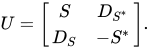
Returning to the general case of a contraction T, every contraction T on a Hilbert space H has an isometric dilation, again with the calculus property, on

given by
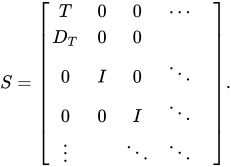
Substituting the S thus constructed into the previous Sz.-Nagy unitary dilation for an isometry S, one obtains a unitary dilation for a contraction T:

![[icon]](#/media/File:Wiki_letter_w_cropped.svg)

