TX-1000 series
Japanese train type
From Wikipedia, the free encyclopedia
The TX-1000 series (TX-1000系) is an electric multiple unit (EMU) train type operated by the Metropolitan Intercity Railway Company on the Tsukuba Express line in the Kantō region of Japan since 2005. A total of 84 cars were delivered.

| TX-1000 series | |
|---|---|
Tsukuba Express 1000 series | |
| In service | 2005–present |
| Manufacturer | Kawasaki Heavy Industries |
| Built at | Kobe |
| Constructed | 2003–2005 |
| Number built | 84 vehicles (14 sets) |
| Number in service | 84 vehicles (14 sets) |
| Formation | 6 cars per trainset |
| Fleet numbers | 01-14 |
| Operator | Metropolitan Intercity Railway Company |
| Depot | Moriya |
| Line served | Tsukuba Express |
| Specifications | |
| Car body construction | Aluminium |
| Car length |
|
| Width | 2,950 mm (9 ft 8 in) |
| Height | 4,070 mm (13 ft 4 in) |
| Doors | 4 pairs per side |
| Maximum speed | 130 km/h (80 mph) |
| Traction system | PWM-VVVF |
| Power output | 190 kW per motor |
| Acceleration | 3.0 km/(h⋅s) (1.9 mph/s) |
| Deceleration |
|
| Electric systems | 1,500 V DC (overhead wire) |
| Current collection | Pantograph |
| Safety systems | ATC, ATO |
| Track gauge | 1,067 mm (3 ft 6 in) |
Design
The TX-1000 series trains use unpainted double-skin aluminium body construction assembled with friction stir welding. They are used only on the Akihabara – Moriya section of the Tsukuba Express line, which is electrified at 1,500 V DC, as the rest of the line is electrified at 20 kV AC; services beyond Moriya to Tsukuba are operated by dual-voltage TX-2000 series sets only.[1]
Formation
| Car No. | 1 | 2 | 3 | 4 | 5 | 6 |
|---|---|---|---|---|---|---|
| Designation | CT1 | M1 | T' | M1' | M2' | CT2 |
| Numbering | 1100 | 1200 | 1300 | 1400 | 1500 | 1600 |
| Capacity Total/seated |
147/48 | 158/51 | 158/54 | 158/54 | 158/51 | 147/48 |
| Weight (t) | 30.3 | 33.6 | 26.5 | 33.8 | 31.3 | 30.9 |
Car 2 is fitted with one single-arm pantograph and car 4 is fitted with two.[2]
Interior
Passenger accommodation consists of longitudinal bucket-style seating throughout.[1]
 Interior
 Priority seating
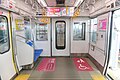 Wheelchair space


History
The first 6-car prototype was built in March 2003 by Kawasaki Heavy Industries, and 13 more sets were subsequently delivered between March 2004 and January 2005.
