According to Lord Kelvin's equation of 1871,[1][2]

where
 = vapor pressure at a curved interface of radius
 = vapor pressure at flat interface (
 ) =
) = 
 = surface tension
 = density of vapor
 = density of liquid
 ,
,  = radii of curvature along the principal sections of the curved interface.
Note: Kelvin defined the surface tension as the work that was performed per unit area by the interface rather than on the interface; hence the term containing has a minus sign. In what follows, the surface tension will be defined so that the term containing has a plus sign.
If the particle is assumed to be spherical, then  .
.
Since  ,
then
,
then  .
.
Hence
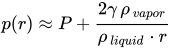 .
.
Assuming that the vapor obeys the ideal gas law, then

where
 = mass of a volume
  of vapor
 = molecular weight of vapor
 = number of moles of vapor in volume of vapor
 = ideal gas constant =
 = Avogadro’s number
 = Boltzmann's constant
 = absolute temperature.
Since  mass of one molecule of vapor or liquid, then
 volume of one molecule
  .
.
Hence
 ,
,
where 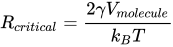 .
.
Thus
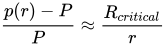 .
.
Since 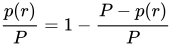 , then
  .
.
Since  , then
 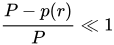 .
.
If  , then
  .
.
Hence
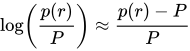 .
.
Therefore
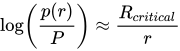 ,
,
which is the Ostwald-Freundlich equation.
Cwkmail (talk) 10:50, 20 February 2013 (UTC)
- I have added this to the article. Arbitrarily0 (talk) 19:35, 9 January 2014 (UTC)

.jpg)


