I'm satisfied with the thorough revision done by User:RockMagnetist_(DCO_visiting_scholar), if not for the fact that the presentation of the non-stationary case has been completely removed, with the current article that entirely relies on the hypothesis that the flow is stationary, without acknowledging it. Worst, by warning that a relation between the distributions E and I holds only at steady state (in Residence_time#Distributions), the article fools the reader in implying that the rest of it holds also in the general case of non-stationary flow.
Before being rewritten (see Special:Permalink/837100972#Definition), the article showed that if the flow isn't stationary then the age distribution function (and consequently the residence time) changes with time. Indeed, note that in the current article t represents the age, while in the old revision t represents the time and and u the age. The old revision, which relies on a single primary source, starts with the definition of the persistence function  instead of the time distribution or exit age distribution
  . But if we allow the latter to change with time, then the two are almost the same:
  . —Esponenziale (talk) 14:02, 17 August 2019 (UTC)
- The relation is actually
 —Esponenziale (talk) 21:44, 26 August 2019 (UTC)
- @Esponenziale: Thanks for the feedback. Although I agree that something should be said about the non-stationary case, I don't think it merits a full-blown treatment, because 1) the more general expressions are a bit cumbersome, 2) the source for them (Schwartz) ends up concluding that (aside from extreme cases) the stationary approximation is likely to be good enough, and 3) the paper only got 22 citations. So for the sake of readability and due weight, it should only get a brief discussion with a minimum of equations. I'll see what I can come up with. RockMagnetist (DCO visiting scholar) (talk) 16:04, 21 August 2019 (UTC)
- @RockMagnetist (DCO visiting scholar): I agree with you that the treatment of the non-stationary case in the old article wasn't satisfactory (although I was the author of it) and specifically that, without any additional source, we shouldn't go into much detail. Note only that the stationary approximation has been found to be good enough for the purpose of Schwartz, that is the study of water reservoirs, but not necessarily for other applications. And is quite common for flows to be non-stationary. —Esponenziale (talk) 16:31, 21 August 2019 (UTC)
- Maybe there are other cases where it's important, but without the sources I can't really comment on that. I have added some material based on the abstract of the article. What do you think? RockMagnetist (DCO visiting scholar) (talk) 16:41, 21 August 2019 (UTC)
- It's possible that this work hasn't received much attention because residence times are only useful when they summarize simple systems. If the flow is highly non-steady, maybe it's better to go with a full-blown treatment of kinetics. But that's just my own view. RockMagnetist (DCO visiting scholar) (talk) 16:51, 21 August 2019 (UTC)
- In my opinion it would it be better to make the hypothesis explicit from the beginning, in Residence_time#Distributions. I'll brush up on the subject and I'll try to propose an edit as soon as I find some time, in the forthcoming weeks. In the meantime, thank you for all the work you've done. —Esponenziale (talk) 17:10, 21 August 2019 (UTC)
- You're welcome! RockMagnetist (DCO visiting scholar) (talk) 17:33, 21 August 2019 (UTC)
- Ok, I allowed the distributions to change with time from the beginning. The generalization weight a bit on the math because requires functions of two variables instead of one and, worst, it isn't exactly what any of the reference express. But conceptually the rework of the references is actually very very simple. And the benefits are great: in my opinion the generalization, beyond the value that has in itself, allows for quite a better understanding. I hope you find it satisfactory, and I'm open to discussion.—Esponenziale (talk) 00:25, 24 August 2019 (UTC)
- I'll have a look. But just at a glance I see one problem - you use more mathematical notation than any of the sources. I think the way they treat the math is a good indication of the level that readers will find comfortable. If anything, it should be less technical so casual readers will not be discouraged. RockMagnetist (DCO visiting scholar) (talk) 02:18, 24 August 2019 (UTC)
- The overall approach is good, and I like the diagram you added. I simplified it a fair bit, saying in English much of what you put in mathematical notation. I think most readers will prefer this less mathematical notation. RockMagnetist (DCO visiting scholar) (talk) 15:32, 24 August 2019 (UTC)
- I'm a big supporter of brevity and simplicity and I sincerely appreciate your effort in this direction. But, as we all know, along this path one should keep oversimplification and vagueness in check. Specifically, regarding your concern about mathematical notation, my opinion is that is better to repeat the concepts both in words and mathematical notation, because the first can be easily too vague. I think that we should just surrender to the fact that we can't write the article, or at least this section, for a reader that doesn't know what functions are.
- Most importantly, with your latest revision you've introduced some serious conceptual mistakes:
- The assumption that the flow is conservative is unnecessary in order to define the age distribution and the exit age distribution. The assumption is necessary only for the relation between I and E to hold true.
- Steady flow means that all the variables that describe the flow don't change with time and it has nothing to do with
 .
.
- The assumption that m stands for mass is unnecessary.
- I take the opportunity to point out also that to indicate a function one should use
 , not
, not  , because the latter stands for the value that the function has in x. And for indicating a partial derivative one should use
  or
or  , not
, not  .
.
- I'll correct the mistakes by reverting back some parts of my previous iteration.—Esponenziale (talk) 17:23, 24 August 2019 (UTC)
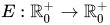
- I apologize for introducing more mistakes - this isn't my area of expertise, and I suspect you know a lot more about it. However, I strongly recommend that you don't re-introduce notation like
![{\displaystyle E:\mathbb {R} _{0}^{+}\rightarrow [0,1]}](//wikimedia.org/api/rest_v1/media/math/render/svg/35fad2844e646b96e09ae76015b89feff0d32cda) . The sources manage without it, and the great majority of readers will be intimidated by it. By all means correct the mistakes, but please do it by editing what's there. RockMagnetist (DCO visiting scholar) (talk) 17:31, 24 August 2019 (UTC)
. The sources manage without it, and the great majority of readers will be intimidated by it. By all means correct the mistakes, but please do it by editing what's there. RockMagnetist (DCO visiting scholar) (talk) 17:31, 24 August 2019 (UTC)
- Ok, I agree that the definitions of the domain and codomain of the distributions are not of great importance and I've removed them altogether.—Esponenziale (talk) 17:56, 24 August 2019 (UTC)


![{\displaystyle E:\mathbb {R} _{0}^{+}\rightarrow [0,1]}](http://wikimedia.org/api/rest_v1/media/math/render/svg/35fad2844e646b96e09ae76015b89feff0d32cda)