Taylor scraping flow
From Wikipedia, the free encyclopedia
In fluid dynamics, Taylor scraping flow is a type of two-dimensional corner flow occurring when one of the wall is sliding over the other with constant velocity, named after G. I. Taylor.[1][2][3]
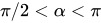
Consider a plane wall located at in the cylindrical coordinates , moving with a constant velocity towards the left. Consider another plane wall(scraper), at an inclined position, making an angle from the positive direction and let the point of intersection be at . This description is equivalent to moving the scraper towards right with velocity . The problem is singular at because at the origin, the velocities are discontinuous, thus the velocity gradient is infinite there.


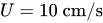
Taylor noticed that the inertial terms are negligible as long as the region of interest is within ( or, equivalently Reynolds number ), thus within the region the flow is essentially a Stokes flow. For example, George Batchelor gives a typical value for lubricating oil with velocity as .[4] Then for two-dimensional planar problem, the equation is




where is the velocity field and is the stream function. The boundary conditions are






![{\displaystyle f(\theta )={\frac {1}{\alpha ^{2}-\sin ^{2}\alpha }}[\theta \sin \alpha \sin(\alpha -\theta )-\alpha (\alpha -\theta )\sin \theta ]}](https://wikimedia.org/api/rest_v1/media/math/render/svg/db4339c648cb7e0a5d9923945af2b3c5b42b568c)
![{\displaystyle {\begin{aligned}u_{r}&={\frac {U}{\alpha ^{2}-\sin ^{2}\alpha }}\{\sin \alpha [\sin(\alpha -\theta )-\theta \cos(\alpha -\theta )]+\alpha [\sin \theta -(\alpha -\theta )\cos \theta ]\}\\u_{\theta }&=-{\frac {U}{\alpha ^{2}-\sin ^{2}\alpha }}[\theta \sin \alpha \sin(\alpha -\theta )-\alpha (\alpha -\theta )\sin \theta ]\end{aligned}}}](https://wikimedia.org/api/rest_v1/media/math/render/svg/a80e9582b682f77616823753d4e7076a18f60a23)










![{\displaystyle \mu =m_{z}\left\{4\left[{\frac {\partial }{\partial r}}\left({\frac {1}{r}}{\frac {\partial \psi }{\partial \theta }}\right)\right]^{2}+\left[{\frac {1}{r^{2}}}{\frac {\partial ^{2}\psi }{\partial \theta ^{2}}}-r{\frac {\partial }{\partial r}}\left({\frac {1}{r}}{\frac {\partial }{\partial r}}\right)\right]^{2}\right\}^{(n-1)/2}}](https://wikimedia.org/api/rest_v1/media/math/render/svg/771fdda87c22246761f0e7c8d544be83ff7c84d3)


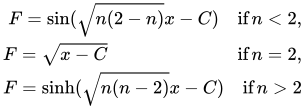
![{\displaystyle \psi =Ur\left\{\left[1-{\frac {{\mathcal {J}}_{1}(\theta )}{{\mathcal {J}}_{1}(\alpha )}}\right]\sin \theta +{\frac {{\mathcal {J}}_{2}(\theta )}{{\mathcal {J}}_{1}(\alpha )}}\cos \theta \right\}}](https://wikimedia.org/api/rest_v1/media/math/render/svg/60927efcaeeea62607bc446e8184d0d0647d844d)