Ten-lined June beetle
Species of beetle
From Wikipedia, the free encyclopedia
The ten-lined June beetle (Polyphylla decemlineata), also known as the watermelon beetle, is a scarab beetle found in the western United States and Canada. The adults are attracted to light and feed on foliage. They can make a hissing sound when touched or otherwise disturbed, which can resemble the hissing of a bat. This sound is made by their wings pushing down, forcing the air out between their wings and back. They can be an agricultural pest affecting a wide range of crops because their larvae feed on plant roots and can weaken or kill the plants.[1]

| Ten-lined June beetle | |
|---|---|
| |
Scientific classification  | |
| Kingdom: | Animalia |
| Phylum: | Arthropoda |
| Clade: | Pancrustacea |
| Class: | Insecta |
| Order: | Coleoptera |
| Suborder: | Polyphaga |
| Infraorder: | Scarabaeiformia |
| Family: | Scarabaeidae |
| Genus: | Polyphylla |
| Species: | P. decemlineata |
| Binomial name | |
| Polyphylla decemlineata (Say, 1823) | |
Description
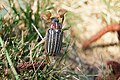
They are relatively large in size, some growing to sizes as large as 1.5 inches (3 cm) or more. As in other members of this genus, the males have large distinctive antennae consisting of several lamellate plates, which they close up when threatened. The antennae are used to detect pheromones emitted by the females.[2] The wing covers (elytra) have four long white stripes and one short stripe each. The underside of the thorax is covered with brownish hairs.
.jpg)
Identification
This species is commonly confused with Polyphylla Critina, also known as the Long Haired June Beetle. Polyphylla Decemlineata, or the ten-lined June beetle, has scales on the protonum. The Long Haired June beetle (Polyphylla Critina) instead has setae (hair) on the protonum. Due to this difference, these species require high resolution photos for differentiation between the two.
Life cycle
Eggs: The eggs are oval, dull, and creamy. They are about 1/16 of an inch long.[3]
Larva: The grub can grow up to 2 inches with 3 pairs of legs, with a white body and brown head. The larval stage can last as long as 4 years.
 Dorsal side â
 Ventral side â
 Ten Lined June Beetle â
 Ten Lined June Beetle - Open â
- Coming back to life after a cool night


