Tengger Desert
Desert in China
From Wikipedia, the free encyclopedia
The Tengger Desert or Tengri Desert (Mongolian: Тэнгэр элс, Chinese: 腾格里沙漠; pinyin: Ténggélǐ Shāmò; lit. 'Sky Desert') is an arid natural region that covers about 36,700 km2 and is mostly in the Inner Mongolia Autonomous Region in China, with a small portion extending into northwestern Ningxia Hui Autonomous Region.

Tengger Desert
Tengri Desert Тэнгэр элс / 腾格里沙漠 | |
|---|---|
Landscape of the southern fringe of the Tengger Desert | |
 Map of China with Inner Mongolia highlighted in orange except Alxa League, where the desert is located, highlighted in red. | |
| Country | China |
| Area | |
• Total | 36,700 km2 (14,200 sq mi) |
| Elevation | 1,400 m (4,600 ft) |
| Tengger Desert | |||||||||||
|---|---|---|---|---|---|---|---|---|---|---|---|
| Chinese name | |||||||||||
| Chinese | 腾格里沙漠 | ||||||||||
| |||||||||||
| Mongolian name | |||||||||||
| Mongolian Cyrillic | Тэнгэр элс | ||||||||||
| Mongolian script | ᠲᠩᠷᠢ ᠡᠯᠡᠰᠦ | ||||||||||
| |||||||||||

The desert is expanding in size.[1]
Environmental issues
The expansion of the Tengger and its neighbour, the Badain Jaran Desert, has been apparent since the 1950s, when large volumes of water were diverted from rivers to feed agricultural expansion and huge tracts of forest were removed. Since 1958, local governments have mobilised residents for afforestation campaigns to prevent the desert's spread. By 2004, the desert's expansion was estimated as 10 metres per year in some areas.[2] In 2007, a non-profit organisation founded by residents of Minqin County created square ditches lined with hay and grass that they later planted with saxaul to stabilise the sand dunes.[2] In 2010, the central and regional governments announced a five-year reforestation plan to create a 202-km green belt between the Tengger and Badain Jaran deserts. The project was estimated to receive 280 million yuan in funding and involve the relocation of 1,000 residents.[3]
Features
 Camel ride in the Tengger Desert, August 19, 2005
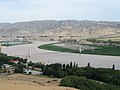 Shapotou District, Tengger Desert
 A view of the Tengger Desert
 A view of the Tengger Desert

.jpg)

.jpg)
