A naive solution is for the spider to remain horizontally centred, and crawl up to the ceiling, across it and down to the fly, giving a distance of 42 feet. Instead, the shortest path, 40 feet long, spirals around five of the six faces of the cuboid. Alternatively, it can be described by unfolding the cuboid into a net and finding a shortest path (a line segment) on the resulting unfolded system of six rectangles in the plane. Different nets produce different segments with different lengths, and the question becomes one of finding a net whose segment length is minimum.[2] Another path, of intermediate length 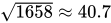 , crosses diagonally through four faces instead of five.[3]
For a room of length l, width w and height h, the spider a distance b below the ceiling, and the fly a distance a above the floor, length of the spiral path is  while the naive solution has length
 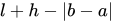 .[1] Depending on the dimensions of the cuboid, and on the initial positions of the spider and fly, one or another of these paths, or of four other paths, may be the optimal solution.[4] However, there is no rectangular cuboid, and two points on the cuboid, for which the shortest path passes through all six faces of the cuboid.[5]
A different lateral thinking solution, beyond the stated rules of the puzzle, involves the spider attaching dragline silk to the wall to lower itself to the floor, and crawling 30 feet across it and 1 foot up the opposite wall, giving a crawl distance of 31 feet. Similarly, it can climb to the ceiling, cross it, then attach the silk to lower itself 11 feet, also a 31-foot crawl.[6]
