Thelocactus hexaedrophorus
From Wikipedia, the free encyclopedia
| Thelocactus hexaedrophorus | |
|---|---|
 | |
Scientific classification  | |
| Kingdom: | Plantae |
| Clade: | Tracheophytes |
| Clade: | Angiosperms |
| Clade: | Eudicots |
| Order: | Caryophyllales |
| Family: | Cactaceae |
| Subfamily: | Cactoideae |
| Genus: | Thelocactus |
| Species: | T. hexaedrophorus |
| Binomial name | |
| Thelocactus hexaedrophorus | |
| Synonyms | |
|
List
| |

Thelocactus hexaedrophorus is a species of cactus. It is endemic to Mexico.
Thelocactus hexaedrophorus grows solitary, it is a spherical cactus, 3 to 7.5 cm (1.2 to 3.0 in) tall and 8 to 15 cm (3.1 to 5.9 in) in diameter, with a bluish, olive-green, or gray-green body. It has 8 to 13 ribs dissolved into warty, six-sided tubercles, 8 to 20 mm (0.31 to 0.79 in) long and 13 to 26 mm (0.51 to 1.02 in) wide. Areoles are 4 to 13 mm (0.16 to 0.51 in) long, spaced 2 to 3.5 cm (0.79 to 1.38 in) apart. The plant features 4 to 8 radial spines, 5 to 60 mm (0.20 to 2.36 in) long, in colors ranging from white to ocher, reddish, or brown, and a central spine 2 to 3 cm (0.79 to 1.18 in) long. Flowers are large, 5 to 10 cm (2.0 to 3.9 in) wide, ranging from white to pale pink. The fruits are green to magenta, 7 to 11 mm (0.28 to 0.43 in) in size, and dry when open.[2]
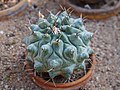 Plant
Plant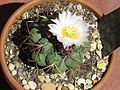 Blooming Plant
 Flowers
 Pink flower form
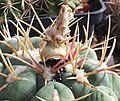 Fruit
Fruit


Distribution
Thelocactus hexaedrophorus is endemic to the limestone slopes in the Chihuahuan Desert, savanna, and grasslands of San Luis Potosí, Zacatecas, Tamaulipas, and Nuevo León, Mexico at elevations between 1100 and 2000 meters. Plants are found growing along with Mammillaria parkinsonii, Mammillaria aureilanata, Ariocarpus retusus, Turbinicarpus saueri subsp. knuthianus , Coryphantha maiz-tablasensis, Astrophytum myriostigma, Echinocactus platyacanthus, Echinocereus enneacanthus var. carnosus, Coryphantha cornifera, Ferocactus latispinus, Echinocereus pectinatus, Echinocereus cinerascens, Opuntia rastrera, Opuntia lindheimeri, Cylindropuntia imbricata, Myrtillocactus geometrizans, Polaskia chende, Agave salmiana, Yucca filifera, Jatropha dioica and Fritillaria affinis.[3]
 Plant growing in Guadalcázar, San Luis Potosí
 Plant growing near La Muralla, San Luis Potosí
.jpg)
.jpg)


