Theoretical strength of a solid
From Wikipedia, the free encyclopedia
The theoretical strength of a solid is the maximum possible stress a perfect solid can withstand. It is often much higher than what current real materials can achieve. The lowered fracture stress is due to defects, such as interior or surface cracks. One of the goals for the study of mechanical properties of materials is to design and fabricate materials exhibiting strength close to the theoretical limit.
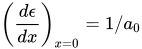
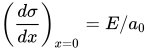
When a solid is in tension, its atomic bonds stretch, elastically. Once a critical strain is reached, all the atomic bonds on the fracture plane rupture and the material fails mechanically. The stress at which the solid fractures is the theoretical strength, often denoted as . After fracture, the stretched atomic bonds return to their initial state, except that two surfaces have formed.

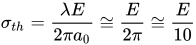
The theoretical strength is often approximated as: [1][2]

where
- is the maximum theoretical stress the solid can withstand.
- E is the Young's Modulus of the solid.