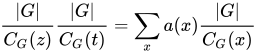
If a finite group G has exactly two conjugacy classes of involutions with representatives t and z, then the Thompson order formula (Aschbacher 2000, 45.6) (Suzuki 1986, 5.1.7) states

Here a(x) is the number of pairs (u,v) with u conjugate to t, v conjugate to z, and x in the subgroup generated by uv.
Harris (1972, 3.10) gives the following more complicated version of the Thompson order formula for the case when G has more than two conjugacy classes of involution.
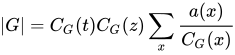
where t and z are non-conjugate involutions, the sum is over a set of representatives x for the conjugacy classes of involutions, and a(x) is the number of ordered pairs of involutions u,v such that u is conjugate to t, v is conjugate to z, and x is the involution in the subgroup generated by tz.