Thurston norm
From Wikipedia, the free encyclopedia
In mathematics, the Thurston norm is a function on the second homology group of an oriented 3-manifold introduced by William Thurston, which measures in a natural way the topological complexity of homology classes represented by surfaces.
Let be a differentiable manifold and . Then can be represented by a smooth embedding , where is a (not necessarily connected) surface that is compact and without boundary. The Thurston norm of is then defined to be[1]


- ,
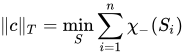
where the minimum is taken over all embedded surfaces (the being the connected components) representing as above, and is the absolute value of the Euler characteristic for surfaces which are not spheres (and 0 for spheres).



This function satisfies the following properties:
- for ;
- for .




These properties imply that extends to a function on which can then be extended by continuity to a seminorm on .[2] By Poincaré duality, one can define the Thurston norm on .


When is compact with boundary, the Thurston norm is defined in a similar manner on the relative homology group and its Poincaré dual .

It follows from further work of David Gabai[3] that one can also define the Thurston norm using only immersed surfaces. This implies that the Thurston norm is also equal to half the Gromov norm on homology.


