Tilakari Madrasa
Religious educational institution in Samarkand, Uzbekistan
From Wikipedia, the free encyclopedia
The Tilakari Madrasa[1][a] (from Classical Persian: مدرسۀ طلاکاری, romanized: Madrasa-yi Ṭilākārī, lit. 'the Madrasa of Gilding, the Gilded Madrasa'; Uzbek: Tillakori madrasasi) is a 17th-century madrasa (Islamic school) located on the Registan in the historic center of Samarkand, a UNESCO World Heritage Site in Uzbekistan.[6]

| Tilakari Madrasa | |
|---|---|
Tillakori madrasasi | |
| |
 Interactive map of the Tilakari Madrasa area | |
| General information | |
| Type | Madrasa |
| Location | Samarkand, Uzbekistan |
| Coordinates | 39°39′21″N 66°58′30″E |
| Inaugurated | 1646-1660 |
| Part of the World Heritage site "Samarkand – Crossroad of Cultures" | |
Background
The Tilakari Madrasa is the youngest monument in the monumental ensemble of Registan, which is formed by the Ulugh Beg Madrasa, the Sherdar Madrasa and the Tilakari Madrasa.[7] It was built between 1646 and 1660, ten years after the Sherdar Madrasa. The madrasa was not only used for the education of students but was also one of the most important mosques for a long time.
.jpg)
The Tilakari Madrasa is widely regarded as a masterpiece of Timurid architecture, a tradition deeply rooted in the Persianate architectural and artistic legacy that dominated Central Asia during the 14th–17th centuries. Rather than belonging to a generalized category of “Turkic architecture,” the madrasa reflects the refined aesthetics developed in Iran, Khurasan, and Transoxiana, where Persian cultural and artistic norms shaped the visual identity of the Timurid Empire.[8][9]
Scholars such as Lisa Golombek, Donald Wilber, Sheila Blair, Jonathan Bloom, and Bernard O’Kane identify Timurid architecture as the culmination of the Persian architectural tradition, characterized by monumental pishtaq façades, intricate mosaic and glazed tilework, muqarnas vaulting, and richly ornamented interiors.[10][11][12]
UNESCO likewise describes the Registan complex—including the Tilakari Madrasa—as part of the broader Persian-influenced cultural landscape of Samarkand, shaped by craftsmen brought from cities like Shiraz, Tabriz and Isfahan.[13]
The lavish interior of the Tilakari Madrasa, covered with gilded surfaces and a dense program of floral and geometric patterns, exemplifies the Timurid mastery of decorative arts. Its tilework, calligraphy, and structural composition closely parallel those of major Iranian and Khurasani monuments, reflecting shared workshops, technologies, and artistic conventions across the region.[14][15] The madrasa's harmonious proportions, turquoise-and-gold palette, and synthesis of spatial and ornamental design make it one of the finest surviving examples of the Persianate Timurid architectural style, rather than a representative of a pan-Turkic artistic category.[16][17]

Gallery
- Exterior
 View from the Registan
 Side view of the madrasa
 Two storied iwans
 Banna'i decoration on the side of the madrasa
 Main entrance iwan
 Decoration of the entrance
 Vaulting inside the iwan
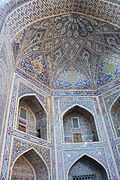 Mini iwans
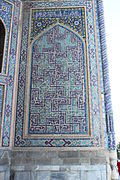 Banna'i decoration
 Decoration of the main entrance
 Decoration of the spandrel
 Glazed spiral fluted column
 Iwan of the dome
 Cleaning the dome
 Another view of the dome
 Iwan behind main entrance
 Wooden doors
 Classroom entrances
 Inner courtyard iwan
 Decoration and calligraphy of a courtyard iwan
 Banna'i decorative brickwork
 Decoration on the main Iwan
 Brick calligraphy
.jpg)

.jpg)


.jpg)


.JPG)
.jpg)
.jpg)

.jpg)


.jpeg)

.jpg)


.jpg)
- Interior
 Interior
 Ceiling
 Front view

 Muqarnas of the mihrab
 Muqarnas
 Decoration of mihrab
 Detailed calligraphy of the mihrab
 Floral arabesques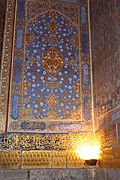
 Calligraphy
 Interior decoration of the dome
 Detailed decoration of the dome
 Upper window
 Squinch transition
 Muqarnas in the squinch
 Decoration of a vault
 Window

.jpg)
.jpg)

.jpg)


.jpg)
.jpg)


.jpg)


.jpg)


.jpg)
- Historical photographs
 Main entrance (1868–1872)
 Mihrab (1868–1872)
 Domed chamber iwan (1868–1872)
 Damaged minaret
 Pulpit (1868–1872)
 1910
1910 1905–1915
_WDL3892.png)
._Prayer_Niche_(Mihrab)_inside_the_Main_Mosque_WDL3845.png)
._Entrance_to_the_Congregational_Mosque_(Friday_Mosque)_WDL3851.png)
._Upper_Part_of_the_Minaret_WDL3811.png)
._Elevation_(Minbar)_inside_the_Main_Mosque_WDL3846.png)


